Larry Page


Before the launch of Android and the T-Mobile G1, Steve Jobs had quite a close relationship with Google co-founders Larry Page and Sergey Brin. Rare pictures of Jobs, Page, and then-Google CEO Eric Schmidt at the Googleplex have surfaced today.
When Sergey Brin and Larry Page stepped down from their management roles at Alphabet this month, many wondered what they’d work on next. A report today reveals that the latter co-founder is particularly interested in one area for his philanthropical efforts: influenza.
Larry Page and Sergey Brin announced this afternoon that current Google CEO Sundar Pichai is also taking on the role of Alphabet chief executive. This is described by the co-founders as a move to simplify management.
Back in April, it emerged that Larry Page and Sergey Brin had not attended a single Google town hall in 2019. A new report today revealed that the co-founders made an appearance at the weekly company meeting last month.
Google has historically maintained an open culture with employees having a lot of input into internal affairs. One aspect to this is a weekly “TGiF” town hall that is a company-wide broadcast. However, founders Larry Page and Sergey Brin haven’t attended these meetings in 2019.

Likely originating out of Page and Pichai’s absence at a recent hearing on Capitol Hill, Bloomberg is out today with a report asking “Where in the World Is Larry Page?” It goes on to detail the Alphabet CEO’s controversial decision to opt-out of the hearing, his broader distancing of himself from the daily politics and issues at Google, and the many distractions that have kept him busy in recent years.

From Electrek:
The flying taxi company Kitty Hawk last night launched ‘Cora’, a Vertical Takeoff and Landing (VTOL) personal airplane/helicopter drone hybrid that will carry a passenger. Kitty Hawk is funded by Google co-founder Larry Page and CEO-ed by Sebastian Thrun, the self-driving car pioneer who is the founding director of Google’s X lab.
Expand
Expanding
Close
Last November, the Securities and Exchange Commission asked Alphabet to further clarify its unique corporate governance structure. Implemented in 2015 as part of a massive reorganization, the SEC wanted insight into the decision-making process within the parent company and its “Other Bets.”
UnitedMasters is a new music label attempting to disrupt the record industry with artist-friendly contracts and data-driven services. Exiting stealth today, it has some unique features and terms that benefit artists, with investment backing from Alphabet.

This past Friday saw a flurry of developments in Waymo’s case against Uber, including the Alphabet company toning down its patent infringement claims to focus on trade secret theft. As part of the upcoming October trial, a magistrate judge has granted Uber the ability to depose Larry Page.
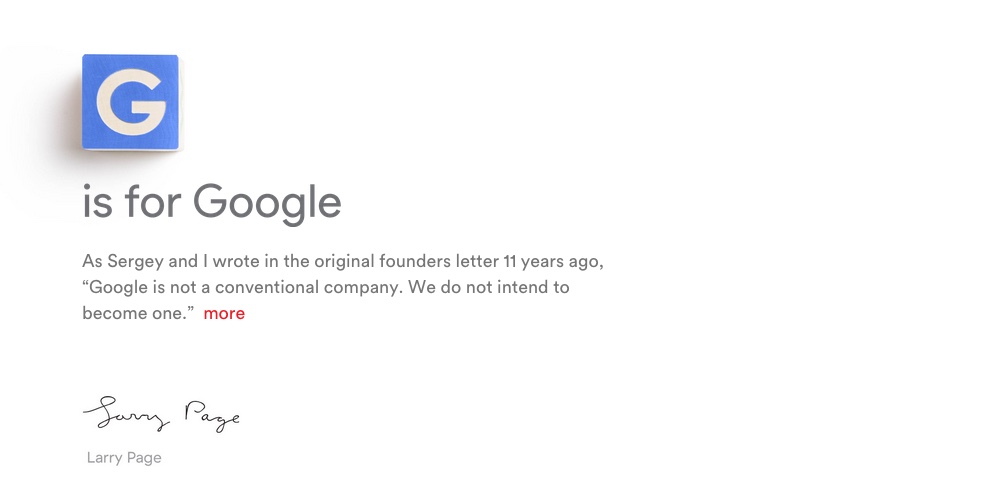
Ahead of the first earnings report for 2017 this afternoon, Alphabet CEO Larry Page has penned a founders’ letter recapping the previous year. Providing an overview on the progress of the various Alphabet bets, Page also touched on machine learning and AI.
A relatively new startup by the name of Kitty Hawk is showing off its all-electric flying ‘car’ for the first time today, almost a year since we first learned that Alphabet CEO Larry Page is one the startup’s biggest backers. While often referred to as a flying car, it’s obvious now that what Kitty Hawk has been working on for the last couple of years is more accurately described as a human-carrying drone…

Google CEO Larry Page speaks at a news conference at the Google offices in New York, Monday, May 21, 2012. (AP Photo/Seth Wenig)
Last week, USA Today shared an article reporting that President-elect Donald Trump has invited top technology leaders to a summit in Manhattan at Trump Tower on December 14. The invitations were reportedly sent by his campaign manager, Reince Priebus, son-in-law Jared Kushner, and transition advisor, Peter Thiel.

The CEO of Google’s parent company, Larry Page, once invited Twitter co-founder Jack Dorsey to Google’s campus to make him an offer for Twitter. That’s according to a Vanity Fair article, which says that Page “sat eerily close to Dorsey” and “whisper[ed] his acquisition pitch into his ear”…

Earlier this year, we wrote a profile on an interesting startup, Zee Aero, developing a battery-powered vertical take-off and landing (VTOL) aircraft near Google’s X lab. The company caught our attention when it started hiring talent from NASA, Tesla and Stanford.
At the time, we couldn’t confirm where the money was coming from, but today we learn that Alphabet’s billionaire CEO Larry Page is secretively behind the electric aircraft startup, reportedly financing it with over $100 million, and even setting up a competing startup, Kitty Hawk, to test another model.
The group’s proximity with Google led a lot of people to believe it was financed by the tech giant, but in fact, Page is financing the initiative himself and not through Alphabet or Google Ventures.
Expand
Expanding
Close
Every year, Larry Page and Sergey Brin write a Founders’ Letter to inform stockholders of recent developments and their vision for the future. For 2016, Page had recently-anointed Google CEO Sundar Pichai write the letter as a majority of ‘bets’ are under his purview. The letter focuses on six main areas.

Update: Elon Musk said in a tweet today that the American Enterprise Institute meeting was not secretive and that he was not there to talk about Trump.
The AEI meeting wasn't secret and I was only there for a few hours to talk about Mars and sustainable energy. Nothing to do with Trump.
— Elon Musk (@elonmusk) March 9, 2016
According to a report from the Huffington Post, Google co-founder Larry Page was among a handful of tech CEOs and Republican establishment members who recently met at the American Enterprise Institute’s World Forum to discuss how to best stop Donald Trump.

it looks like that $10 million offer from Martin Shkreli to exclusively acquire Kanye West’s new album wasn’t even in the ballpark. Today Kanye has taken to Twitter to publicly plead with tech execs for investments as the artist delays the release of his much anticipated album “The Life of Pablo” and cites $53 million in personal debt.

Google co-founder and now Alphabet CEO Larry Page has given his first major interview since the formation of Alphabet, addressing a wide range of topics which include his concerns about heading into uncharted territory with the company, privacy, Project Loon and Steve Jobs …
Expand
Expanding
Close
Fortune reports that Google has abandoned plans to beam location-based retail messages to both Android and iOS smartphones, shortly before launch. The project was reportedly named Google Here, and would have used beacons in retail stores like Starbucks to display offers and reward cards on the lockscreens of smartphones when they entered the store.
Google Here worked by sending a notification to a smartphone user’s lock screen within five seconds of their entering a partner’s location. If the user clicked on the notification, a full screen HTLM5 “app” experience would launch. Google Here would know when to send the notification via Google Maps and beacons placed in the stores of participating partners …

Google’s X lab is famous for its ambitious undertakings building self-driving cars and balloons that beam Internet to the furthest reaches of the planet. Now all of its life sciences projects are moving on to greener pastures.


Yesterday, Google announced a massive restructuring and the creation of a new parent company, Alphabet. While Google will still focus on the traditional internet-related products like Chrome, Android and web search, other company’s will be set up to focus on more exploratory ventures. Along with the announcement yesterday, Alphabet launch its new domain: abc.xyz. Unsurprising to anyone, this new domain is already 100% blocked in China.
The news comes via GreatFire, a site which actively and constantly monitors URLs blocked within China’s borders. Alphabet’s home page has been blocked since it went live yesterday. Although it could be easy to see this as a pre-emptive, and active blocking against Google from China, it’s more likely that the country already blocks any site bearing Google’s SSL certificate. If that’s the case, then it doesn’t matter what site Google launches, it’s blocked before it even goes live in China.
Google and China’s relationship is an interesting one to say the least. Which is to say: They don’t really have one. Google’s products and services are blocked almost completely. Android phones in the mainland don’t have access to Google’s Play Store to download apps, and Play Services are a complete no go. It’s one of the reasons it’s been rumored the company could be partnering with Huawei to launch the next Nexus smartphone. Google apparently hopes it can use Huawei’s Chinese influence to build its own presence and launch services in China.
Career website Glassdoor today has released its annual breakdown of the top 50 CEOs, as voted on by employees. This year, Google CEO Larry Page was voted as the chief executive officer of the year with a 97 percent employee approval rating. Last year, Page was 10th on the list, with LinkedIn CEO Jeff Weiner taking the top spot. Weiner this year fell to 12th overall with an approval rating of 93 percent.
From Electrek:
Elon Musk, although CEO of a company based on Silicon Valley, often finds himself without a place to sleep when he’s away from his $17 million home located in Los Angeles. According to statements from Google CEO Larry Page given to Ashlee Vance for his upcoming book on the Tesla CEO, Musk is “kind of homeless,” and sometimes sleeps over at Page’s house when he’s in town.
“He’s kind of homeless, which I think is sort of funny,” Google CEO Larry Page said. “He’ll e-mail and say, ‘I don’t know where to stay tonight. Can I come over?'”
Larry Page hasn’t “given him a key or anything yet,” though, for his 8,000 square-foot, six bedroom home in Palo Alto. He owns another 6,000 square-foot environmentally friendly mansion on the same property. But maybe it won’t be long—it would make sense that maybe Musk’s focus is more to build out his business relationship with Google. It’s not like he couldn’t afford to sleep in a nice hotel.
The Washington Post put together some other notable quotes from the book.