Chance currently writes for both 9to5Google and 9to5Mac, in addition to 9to5Toys. He has previously written for several other online publications. He uses a Nexus 5, iPhone 5s, iPad Air, Hackintosh, and Macbook Air.
We’ve covered the Chinese search engine giant Baidu before, commonly referred to as “China’s Google”, the search engine is one of the leading sites in web traffic in the country. Looking to further support its title as “China’s Google”, Baidu today made a significant hire. First reported by Technology Review, Baidu has hired Andrew Ng to oversee a new artificial intelligence research lab it is opening in Silicon Valley.
Andrew Ng is a Stanford professor who is most well known for his position at Google, where he was a key component in the company’s “deep learning” field. Ng also cofounded the online education company Coursera.
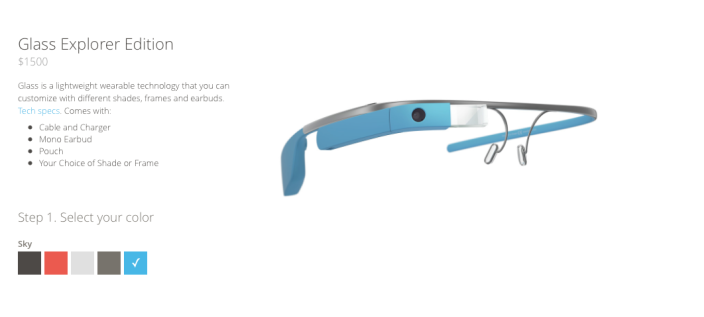
After a brief stint of availability last month, Google Glass is once again available to everyone for purchase. A pair will still run you $1500, but you will also get a free set of Titanium Collection frames for free. Unfortuntely, however, Google has limited the availability to the United States only for the time being.
Google announced the availability of Glass today in a post on Google+. The company says that it is looking to move the product towards a “more open beta,” although it will still carry the “Explorer” branding.
Last week we told you we’d be trying out new ways to find Explorers. Well, we weren’t kidding. We learned a lot when we opened our site a few weeks ago, so we’ve decided to move to a more open beta. We’re still in the Explorer Program while we continue to improve our hardware and software, but starting today anyone in the US can buy the Glass Explorer Edition, as long as we have it on hand: google.com/glass
We’re ready to keep meeting new Explorers, and we can’t wait to hear all your experiences and feedback to continue to make Glass even better, ahead of our wider consumer release.
Head over to the Glass Store to grab your pair – and free titanium frames – today. It’s unclear how long Google will be selling Glass to the public, although it looks like as long as it has it in stock, it will be up for sale. Google sold out of several variants when it put Glass up for sale earlier this year, although it presumably has more units this time around.
XE 17.1 appears to be a rather minor update, but still includes some pretty critical fixes for Glass users. Most notably, the update has reportedly considerably improved general performance with the device. The speed of snapping photos has greatly been improved, as has the responsiveness of the TouchPad. The update also reintroduces the ability to share from places from your Android device with Google Maps to Glass.
The update to MyGlass on Android also appears to be minor, with the most notable changes including the ability use MyGlass to enter Wi-Fi passwords and some interface tweaks.
The XE 17.1 update is supposedly rolling out to Glass users now and will continue to do so for the next several days. The MyGlass update should begin to roll out at any time, as well.
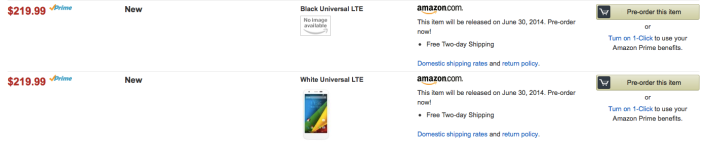
Update: If you click the “ALL” option and scroll down, Amazon now lists the LTE model, in both black and white, as shipping June 30th and costing $219.99.
When we reviewed the $179 Moto G earlier this year, we praised nearly every aspect of it. For the price, there was absolutely nothing better than it on the market. The one thing we missed, however, was LTE capability. In order to keep the cost of the device down, Motorola limited it to HSPA+ speeds. Today, however, two new variants of the Moto G have shown up on Amazon. A Black “Universal LTE” model and a white “Universal LTE” model.”
According to a separate report out of Engadget Mexico, Motorola is also planning a Ferrari branded Moto G that will likely be red with a yellow Ferrari logo. It will reportedly launch in the second half of 2014.
It could be that this is just a mistake on Amazon’s part and that no LTE models of the Moto G are planned. It could also be, however, that this is a sign of things to come and that Motorola is planning to launch an LTE-capable variant soon. The latter corroborates with recent rumors that Motorola is planning some sort of Moto G successor, to be launched very soon. Either way, we’re going to keep our eye on the Amazon page.
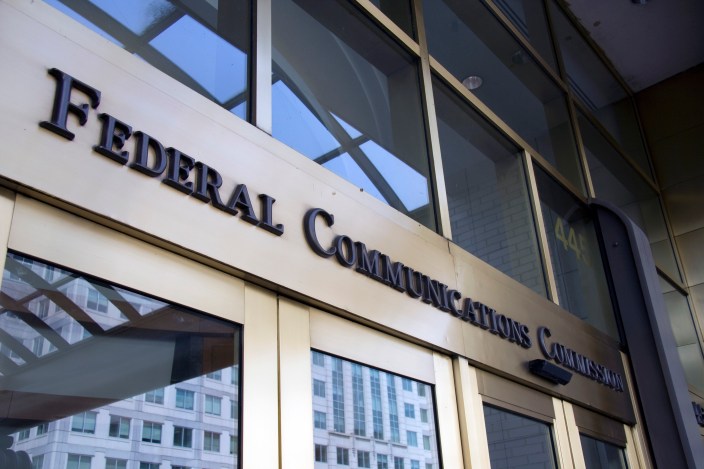
Following a proposal that many fear threatens net neutrality, a plethora of tech companies today have come together to support net neutrality in a letter to the Federal Communications Commission. The group is led by Google, Amazon, Facebook, Microsoft, Netflix, and Twitter, as well as many others.
The letter voices disapproval of a recent proposal that would allow people to pay more in order to gain a higher priority from their internet service provider. The letter focuses on keeping the internet open, and perhaps treated as a utility. The companies make the case that with this new paid prioritization proposition, ISPs would be discriminating both technically and financially against internet companies
Anyone who has followed Google over the past few years knows that it has had more than its fair share of privacy issues. The company’s had run ins with the UK government, US government, and others about privacy concerns, in addition to facing criticism over Google Glass. Microsoft has also mocked Google for its privacy issues as part of its “Scroogled” ad campaign. Now, a German activist group that calls themselves Peng Collective has launched a new website that parodies Google, its privacy issues, and apparent need to know everything about everyone.
Amazon this afternoon has rolled out an update to its official Android app that includes several minor new features and bug fixes. Most notably, the update adds the Single Sign On feature to Amazon’s entire suite of app. This means that if you log into your account through the Amazon app, you’ll automatically be signed in to the company’s other apps, such as Kindle, Amazon Appstore, and Amazon MP3.
We’ve seen several competitors to Google Glass over the past few years, including smart glasses from Vuzix and Epson. The latter of those, in fact, beat Google to the market back in 2012 with its Moverio glasses. Today, Epson has announced its second generation smart glasses, powered by Android.
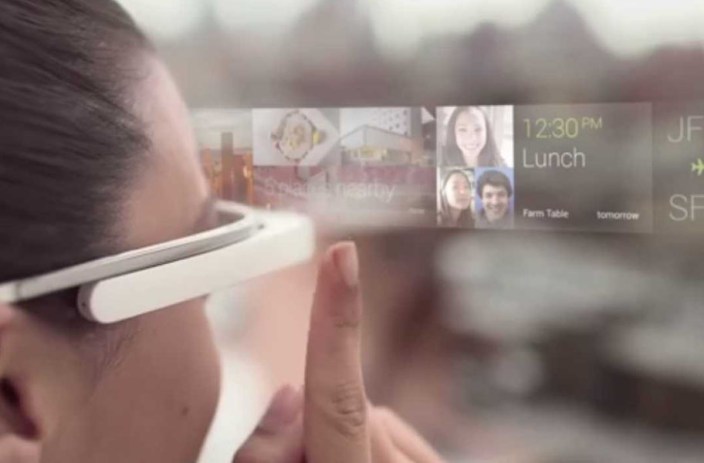
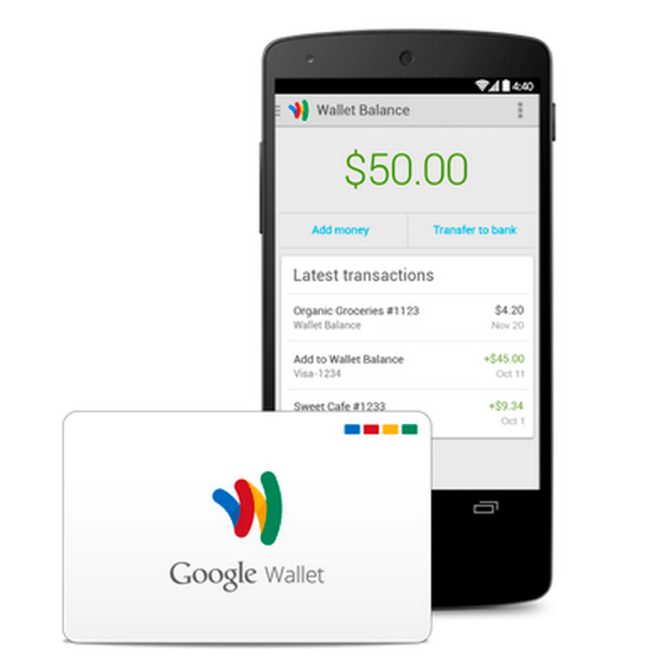
According to a new report out of TechCrunch, Google is working to add Google Wallet functionality to Glass. Citing a “source close to the company”, the report claims that Google is currently testing the feature internally, but that it hopes to make it public in the near future. Currently, Glass users have to be signed in to a computer on Google’s corporate network in order to install the app on their Glass.
Like many features on Glass, Google Wallet will work almost exclusively with voice commands. Users will be able to simply ask Glass to “Send money”, then have the ability to swipe through the interface a view times and your done. One of the most common uses for this would be the ability to send your share of a dinner bill to a friend, much like with the Google Wallet integration in Gmail.
The fees for using Wallet with Glass will be the same as other services, with Google taking a 2.9 percent fee for all transactions. Google is certainly looking to add more practical use cases to Google Glass, and the ability to pay with Wallet will certainly come in handy for users.
Update: It turns out Google Search/Now on Android is also getting a ton of other new features in addition to the ability to find a parked vehicle (via SearchEngineLand):
Offline support: Google Now cards will remain loaded when users lose their internet or mobile connections
Indoor maps: in “some malls” Google Now will offer a searchable directory of stores (US + Japan) and then take users to an indoor map of that mall. We don’t know which particular malls but probably the ones available on the US and Japan lists here. In addition Google has individual store maps (probably coming later) for some retailers such as Best Buy, Home Depot, Ikea and others. It doesn’t have everyone store in those chains however.
Product search reminders: If you’ve done a previous search for a product online or on a mobile device and you happen to be near a store that carries that product, Google will show you a Now card (kind of like a reminder/notification) about the product.
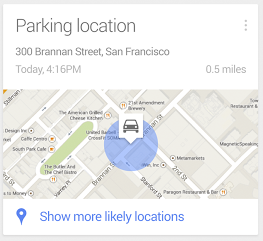
Google this afternoon has updated its Search app on Android with several new features. The update bumps the app to version 3.4 and has some pretty useful features within it. First off, it adds a Google Now card that offers the ability to automatically detect where you’ve parked and help you find that spot later, a feature that was rumored earlier this month.
The new interface features a darker theme with refreshed typography and rounded pictures and album art. The design is nearly identical to that found on iOS and the Spotify desktop app.
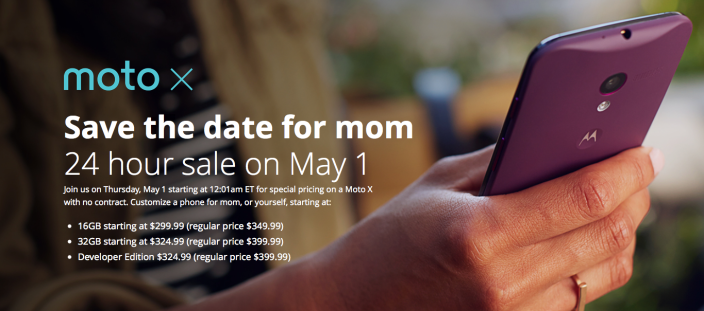
It’s unclear how many units Motorola will sell at this price, or if it will simply run the entire day. You also have to keep in mind that Motorola has promised a new flagship by late-Summer. But if you’ve been waiting for your chance to snag one of the best Android smartphones out there, this is your opportunity.
Samsung, just a week after Apple, has reported its first quarter earnings for 2014. As an entirety, the company reported $51.8 billion in revenue, up slightly over this time last year, coming out to $8.2 billion in operating profit and $7.3 billion in net profit. More specifically, its mobile division accounted for $30.29 billion of that revenue and $6.2 billon of that profit.
Earlier this month, @evleaks tweeted an image of a mysterious device dubbed the HTC M8 Ace. At the time, very few details about it were known. Engadget, however, is now reporting that the HTC M8 Ace will essentially be HTC’s answer to the Galaxy S5, but cheaper.
Much like the Galaxy S5, the M8 Ace will feature an all-plastic design. The specs will also be nearly identical, with the M8 Ace packing a 5-inch 1080p display and a 2.5GHz quad-core Snapdragon 801 processor.
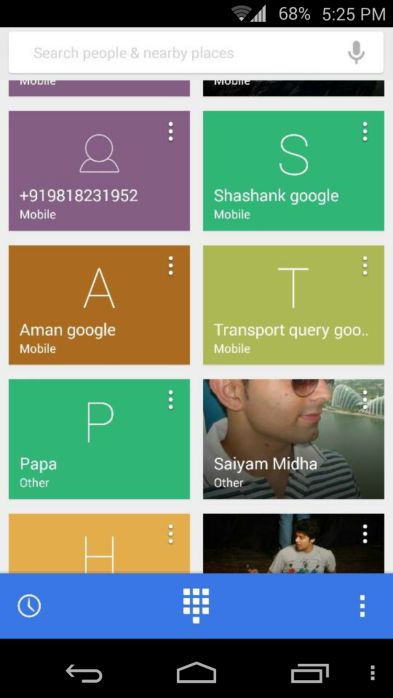
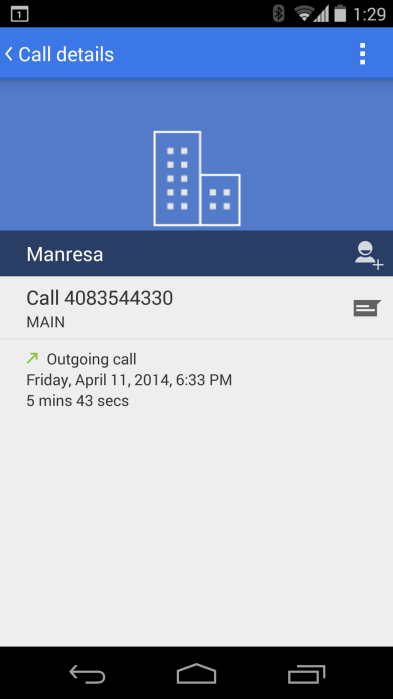
Last week, Google itself tweeted out an image that showed a slightly redesigned dialer app on Android. Not much appeared to be different in the app, though the action bar at the top was a new shade of blue, as opposed to gray. Now, more screenshots of a redesigned dialer app have leaked via an XDA thread.
These images show a few more changes, especially to the contacts portion of the dialer app. Instead of a list like the current dialer app, these images show a picture-heavy design with cards for each contact. If you have an image of the person, you’ll see it on the card, but if not, you’ll see a random color. Overall it looks very similar to the Gmail app and fits in well with the leaked Android app icons and calendar app.
The images come from a friend of the XDA user, who could very well be a Google employee judging by the contact names. Google has said before that it is refocusing on design, and with Google I/O 2014 right around the corner, it seems very plausible that we will see some redesigned apps be unveiled at the event.
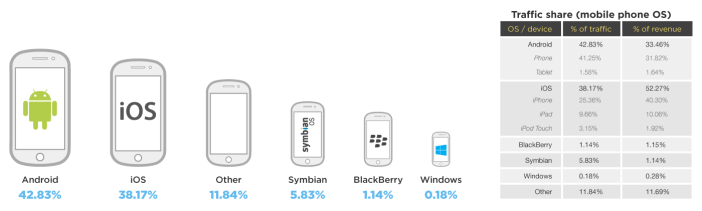
According to a report from mobile ad network provider Opera Mediaworks (via ComputerWorld), Android devices received more ad traffic than iPhones and iPads for the first time ever in the first quarter of 2014. The data shows that Android devices, including both phones and tablets, accounted for 42.8 percent of mobile ad impressions, while iOS devices accounted for slightly lies at 38.2 percent.
iOS devices still led in terms of revenue, however, receiving 52 percent of ad revenue. Android devices climbed to 33.5 percent of revenue, up from 27 percent a year ago. In terms of location, the United States still drives the most mobile ad traffic with 50.6 percent. Asia-Pacific countries were second with 23 percent, and European countries came in with 13 percent.
The sheer volume of Android devices obviously helped Google’s operating system take the crown for the most ad traffic. The IDC reported that Android smartphones made up 78% of all smartphones shipped, compared to 17.6% for iPhones. The fact that iOS led in revenue, however, still shows that iOS is still the more enticing operating system for developers and advertisers. For now.
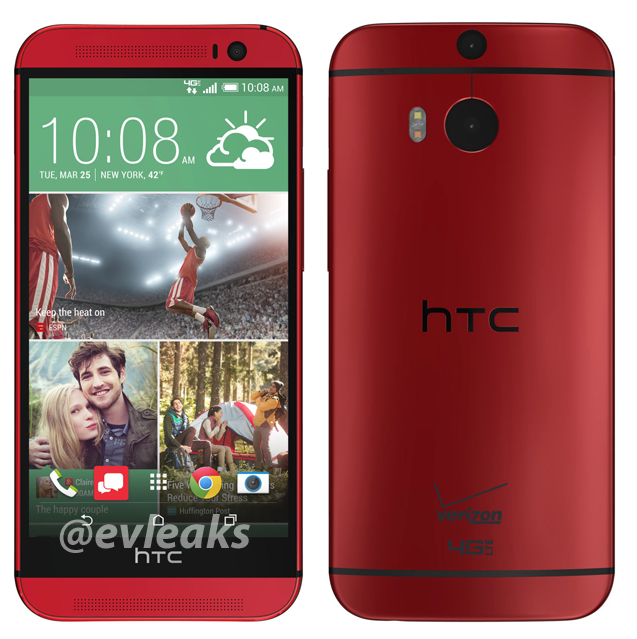
Given that the original HTC One (M7) was available in various colors, it only seems likely that its successor will also be offered in a variety of shades. Notorious Twitter leaker @evleaks has leaked a picture of the HTC One (M8) in a new red color. The device will reportedly be a Verizon exclusive, as evident by the Verizon and 4G LTE branding on the back.
The back of the device is entirely red, with the exception of the branding, camera, and a few black accents. Unlike the red Nexus 5, the front of the device is also red, aside from a small black bezel around the display.
Other than the new red color, the device has the same Sense 6 overlay, Duo Camera, BoomSound speakers, and unibody design. We wouldn’t expect to wait too long for an official announcement from Verizon and/or HTC.
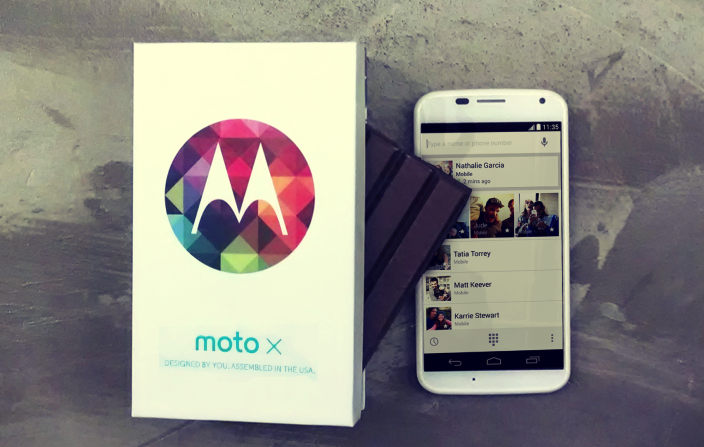
Motorola hasn’t made any official announcements regarding the price drop, but if you head over to the company’s website you can see that the price has dropped with no indication of it being a temporary sale.
On Amazon, the device is also priced the same, but it applies to the unlocked GSM model that will work with AT&T and T-Mobile, not RepublicWireless. That’s even a better deal: $350 for 16GB and $400 for 32GB. The developer edition of the device is still set at its normal $449.99 and it’s unclear if it will receive a price cut.
Nevertheless, if you’ve been waiting for an opportunity to snag Motorola’s darn-good Moto X flagship, now’s your chance.
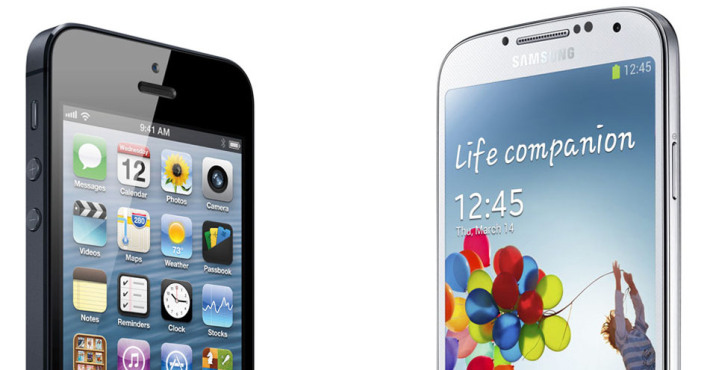
While testifying in the Samsung vs Apple case on Tuesday, it was revealed that Google has agreed to help Samsung defend itself against Apple in its current patent-infringement case. According to a report from Re/Code, citing deposition testimony from Google lawyer James Maccoun, Google has also agreed to partially or fully indemnify Samsung for any loses it may suffer on its claims.
While handling some customer support, the Google Nexus Twitter account has apparently tweeted out a screenshot of a redesigned Dialer app by accident. The interface does not look all that different. The most noticeable change is that the action bar at the top of the interface blue in the leaked screenshot, whereas it is gray in the most recent build of KitKat.
Google is putting its focus back on design with the latest version of Android and at this year’s Google I/O. It would certainly make sense to introduce app redesigns at the event, too. And it looks like we can expect a new Dialer app to be one.
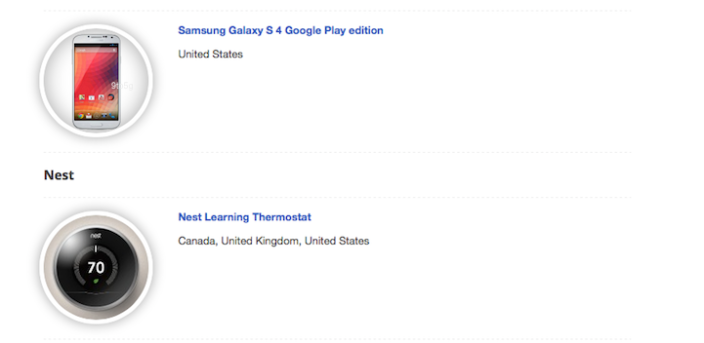
Earlier this year, Google acquired smart thermostat maker Nest for the huge sum of $3.2 billion. This led to speculation that the two companies would work together, with Google using its online retail outlet to boost sales of product. Since the acquisition, however, nothing has come to fruition between the companies, with both continuing business as normal. It looks like, however, that Google may soon start to sell the Nest thermostat via the online Play Store.