Stay up to date on news from Google headquarters. Be the first to learn about plans for Android, Google Plus, Google Apps, and more!
Stay up to date on news from Google headquarters. Be the first to learn about plans for Android, Google Plus, Google Apps, and more!

Football hooligans rejoice! If you’re still following the madness that is the 2014 World Cup and you’re ready to pledge your allegiance to your favorite club, Google has crafted a new way to show your support. Starting today, you can share a picture of yourself and up to four friends on Google+ and let the social network paint your faces with the flag colors of teams in the World Cup’s knockout round.

Google this morning rolled out an update to the Maps app on Android with a feature that will certainly make Google I/O 2014 attendees happy. Bumping the app to version 8.1.1, the update resolves the issues surrounding Android Wear’s compatibility with Google Maps.
Many Google I/O attendees noted that the Maps integration with the new Android Wear devices was entirely nonexistent, despite Google’s on-stage demos. Today’s update, however, adds integration between Wear and Maps like Google showed us during its keynote. With Maps on a smartwatch, you can search for a location and start navigation directly from your wrist. The watch, of course, still communicates with your phone for the data.
Now that Google has officially released the full Android Wear SDK, we expect to see a lot of apps updated with Android Wear support over the coming days and weeks. You can download the Google Maps update on the Play Store now.
For several months now we’ve been hearing rumors that Google’s new Android Silver program was going to replace the Nexus line of devices. This, of course, caused some uproar among the stock Android faithful. David Burke, head of Android engineering and the Nexus program at Google, spoke out in an interview today to put those rumors to rest. Speaking to Read Write, Burke said that people are simply getting excited about the concept of something new (Android Silver) and forgetting about Google’s reasons for the Nexus line in the first place.
“People just get excited by concepts and forget why we do things. We are still invested in Nexus,” he said. “People have been commenting about Nexus because there is something else and they think that means the end of Nexus. That is the totally wrong conclusion to make.”
After calling it the biggest update in Android’s history, Google yesterday announced that it would be making its Android “L” update available, albeit in preview/beta form, to developers today. The files were posted on the company’s official developer website earlier, and since then I’ve installed the preview on my Nexus 5 and been digging through it, seeing what kind of changes I could find, both mentioned and unmentioned by Google…
After its keynote yesterday, Google gave all of its I/O attendees a makeshift virtual reality headset, dubbed Cardboard, because well, it was made out of Cardboard. On its website, Google broke down all the parts you would need if you wanted to build one on your own. It looked relatively easy, but with out the pre-perferated cardboard that Google gave out, it could be tricky. Dodocase, the company behind some of the best looking iPad and iPhone cases, decided to take advantage of the hype surrounding Cardboard and release a kit for making your own.
During a session at its I/O developer conference today, Google announced that it’s partnering with LG to build a tablet that’s part of its Project Tango program to release to consumers next year. Google earlier this month announced that it was releasing a prototype Tango tablet, but only for developers. The version made by LG will be intended for consumers, and presumably, cheaper than the $1024 developer version.
After launching a red color variant earlier this year, it looks like Google is now planning to release a yellow Nexus 5 sometime soon. If you look on the official Android website and scroll down to the Nexus 5 section, you’ll now see that the description touts it as being available in “black, white, red, and yellow.” Prior to the red model of the Nexus 5 launching, there were some whispers of a yellow variant, but nothing ever came of them.
Seeing that the yellow Nexus 5 is listed on the official Android website, it seems likely that it is legit. The only question now is when it will launch officially on the Play Store. We’d assume that the shade of the yellow used will be similar to the bright yellow used on the official Google bumper for the Nexus 5.
With Google I/O taking place this week, it seems like the perfect time to launch a new color variant of the company’s flagship device. Keep your eyes on the Play Store.

Yesterday at its I/O developer conference, Google introduced its new take on bringing the power of Android to the living room with Android TV. Google’s new “L” version of Android will power set-top boxes and full TV sets from Razor, Asus, Philips, Sony and more bringing voice control and gaming capabilities to the entertainment experience.
In addition to making an Android TV SDK available later today so developers can create software for Android TV, Google has already released a remote control app on the Play Store for use with Android TV when it’s available later this year. Google notes that the app is intended to work with the ADT-1 Developer Kit. The app features both a d-pad and touchpad for using your Android device to maneuver around the Android TV interface. Android TV Remote Control is available today on the Play Store.
Expand
Expanding
Close

The WSJ is reporting that Google has begun removing search results following a European court decision that individuals have a right to require Google to remove links to information which is “outdated or irrelevant.”
Following the ruling – known as the ‘right to be forgotten’ – Google created a webpage application and announced that each would be evaluated by hand on a case-by-case basis, balancing the right to privacy against legitimate public interest. The company now says that it has begun acting on these requests …
Expand
Expanding
Close
In addition to its slew of announcements at I/O earlier today, Google this evening rolled out a major update its Search app on Android. Bumping the app to version 3.5.14, the update adds several new features, but the biggest is the ability to activate a voice search from anywhere within the operating system. This feature was initially reported on back in April, but is only now making its way to the app.

Amid protests, Google tries to make nice with the city of San Francisco both with a showing of local bands and some San Francisco related tracks (20) on Google Play available for free. Rumor has it there will also be lots of San Francisco beers at the event this evening.
There is both a lot happening at this year’s Google I/O and very little, depending where you look. Obviously, if you are a developer who builds Android and even web apps, you are a kid in a candy store. If you are looking for new hardware, there isn’t much that wasn’t out there already. Neither Google co-founder took the stage this year after successive years where Sergey Brin led the introduction of Google Glass (which is all but absent this year) and Larry Page led an epic Q&A last year.
https://www.youtube.com/watch?v=d36cIFCJvQs
Google announced a variety of new services and products today at Google I/O, including the “L” version of Android, Android Auto, Android TV, Google Fit, and Android Wear. In an effort to help us all digest this onslaught of news, Google this evening posted a 2-minute video on YouTube showing how all of those services can seamlessly work together to make your life easier.
The video, seen above, shows a man performing daily routine, but with all of Google’s new services. He’s using an Android “L” smartphone paired with an Android Wear watch, paired with a car with Android Auto, paired with Android TV. And, of course, an obligatory cute dog. The video makes it look like it all works pretty seamlessly together. But unfortunately, we’re still quite aways away from this becoming reality.
Last month, Motorola announced that it was accepting design submissions for watch faces for its Moto 360 smartwatch. We showed you some of the best and most interesting submissions last month, as well, but today, Motorola has finally announced the winner of its contest. In a blog post, Motorola announced that out of the 1,300 submitted designs, David Pascual’s watch face was deemed the best. You can see his design at the top of this page.
Motorola says that Pascual wins one of the very first Moto 360s and the chance for his design to be featured on the watch when it ships. It’s unclear exactly what Pascual has to do for his design to be featured on the watch, but we’re guessing there’s some sort of licensing.
You can view all of the Moto 360 watch face designs on Google+. The Moto 360 is slated to go on sale later this summer.
While unveiling the swag it was giving to developers at Google I/O, Sundar Pichai also announced that attendees were getting a piece of cardboard. It turns out that the piece of cardboard is a makeshift virtual reality headset. The company also released a companion app for Cardboard. Essentially, it allows you to slot your device into a cardboard viewer and look at it through a viewfinder and special lenses.
The result is Cardboard, a no-frills enclosure that transforms a phone into a basic VR headset, and the accompanying open software toolkit that makes writing VR software as simple as building a web or mobile app.
As was rumored earlier this month, Google today announced its new Google Fit platform. The service, similar to Apple’s HealthKit, will track all of your health metrics, including sleep, steps, biking, and much more. Google Fit will be built directly into the upcoming “L” version of Android. The “L” version of Android is expected to come out at the same time as iOS 8 and Apple’s HealthKit Platform.
During its annual developer conference today, Google announced several new enterprise features that are coming to Android with its “L” update and a new “Android for Work” program. Thanks to a plethora of new APIs, the “L” version of Android will be able to seamlessly unify personal and business apps and data. Google claims that currently, many employees are required to carry two phones: one for work and one for personal use.
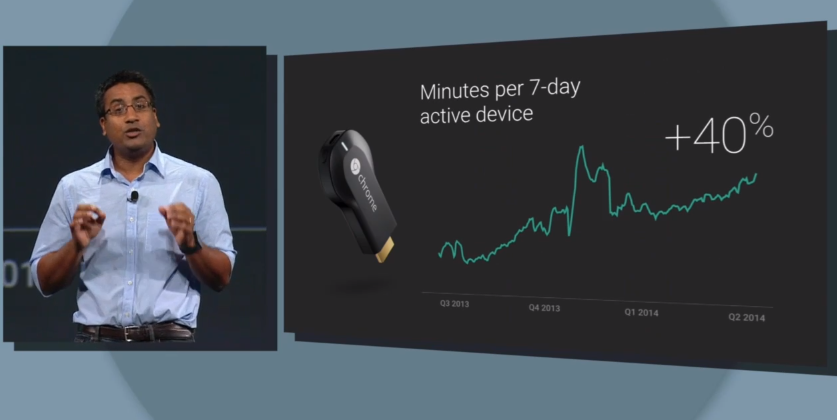
Not only did Google discuss Android TV at Google I/O, the company also discussed its Chromecast HDMI stick that connects content from your smartphone, computer, or tablet to your TV. Rishi Chandra, Google’s Director of Product Management Chromecast, noted that the Chromecast “consistently outsells all other streaming devices combined” at Best Buy and similar retailers. He pointed out that Chromecast tops Amazon in a several countries as well. Since its launch last year, usage has jumped 40% with the majority if views coming from YouTube. A new dedicated site at chromecast.com/apps will now present a list of compatible apps.
Using “the cloud”, Chromecast users can now share content from devices to a Chromecast-connected television without being on the same WiFi connection. A new feature called Backdrop coming later this year will present information like news, weather, and photos on a blank Chromecast to make it useful to have connected to your TV even when you’re not sending content from a device. The Chromecast will also support mirroring from Android on supported devices from HTC, LG, Samsung, and Nexus devices.
Expand
Expanding
Close
On stage at its Google I/O developer conference, the company talked wearables, as we expected it to. Google says that Android users check their phones “an average of 125 times a day,” so the company hopes that Android Wear paired with various wearables will help cut down on this number. Demoing it on an LG G Watch, Google showed more details about the Android Wear interface. The company also announced that starting today, the full Android Wear SDK is available to developers. Most importantly, Google announced that the LG G Watch will be available on Google Play today, although a price is still yet to be determined. The company also announced that the the Samsung Gear Live will be available today, as well. The Moto 360 will be available later this summer.
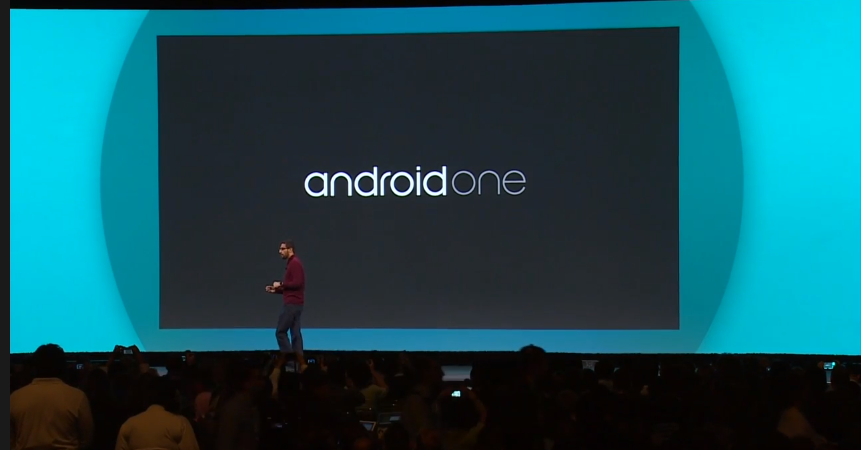
Today at Google I/O, Sundar Pichai announced a new program called Android One. The program will launch in India in the fall with partners including Karbon, Spice, and Micromax. The Android One Software Experience includes stock Android like what is found on Google’s Nexus devices with Play apps auto-installed with automatic updates. The program is intended to create high quality, affordable smartphones for developing markets using easily available parts to keep cost down. As an example, Pichai showed off a sub-$100 smartphone featuring a 4.5-inch display with dual SIM, SD card slot, and FM radio. After launching in India, Google will expand the Android One program.
Expand Expanding Close

Screenshot via Google I/O microsite
With Google I/O kicking off today at 9 am PST/12 pm EST, Google VP Megan Smith tells USA Today that the number of women attending Google’s developer conference has more than doubled since last year’s conference.
She says women will make up 20 percent of the 6,000 software developers. Last year just 8 percent of Google I/O goers were women, a statistic that Smith says is typical of most tech conferences.
“Twenty percent is not 50 percent, which is where we want to be,” she said. “But the trajectory is good.”
Google is also making efforts to increase the stage presence of women on stage and leading sessions, according to Smith, with 25 percent of Google representatives being women this year compared to 16 percent a year ago.
The company recently released data showing that only 30 percent of its employees are women as it expressed it is not where it wants to be in terms of diversity as a company.
Researchers at the University of Massachusetts Lowell have demonstrated an interesting (and slightly scary) technique for using Google Glass to detect phone PINs with 83 percent accuracy from across a room – even when the screen wasn’t visible.
The technique used applies an image-recognition algorithm that doesn’t need direct sight of the screen. Instead, it uses a reference image of the target device to detect the angle at which it’s being held, then tracks the shadows from finger taps to detect which on-screen keys are being pressed …
Expand
Expanding
Close
Earlier today, Bloomberg published a profile of Android head Sundar Pichai in which it was stated that Google has several Android TV announcements slated for its I/O developer conference tomorrow. The WSJ has now published another report corroborating the earlier profile. According to the report, Google on Wednesday will unveil at least one “small set-top box” running its new Android TV operating system.
I missed out scooping the Google Glass skydiving unveil at Google I/O 2012 because I didn’t believe my source. He knew about the entire thing, but it was too unbelievable for me to post. I’m posting this late word from my source because I think there is a small chance that Google announces it tomorrow (by posting late, it hopefully won’t go mainstream and I don’t look like an idiot when it doesn’t happen).
According to the source, Google has some biomedical superstars working in its X Lab on some cutting-edge micro bots that can detect things like certain kinds of cancer. These bots are small enough (the size of blood cells) to fit through human capillaries, yet they can detect diseases in the blood and can trigger an RFID reader, which in turn talks to a watch – perhaps a device running Android Wear. I was told this technology is at least 2 years from being a real product (and likely more when you consider FDA and public outcry). This isn’t the first time we’ve heard of nanobots circulating human bloodstreams, with scientists working on the idea as far back as 2009.
The bots would circulate in your blood stream, and when they went through your wrist (under your watch), the watch would be capable of reading the status (cancer/no cancer etc.).
Similar technology is already well documented and in recent years has become closer to something Google could actually use in a product. Ray Kurzweil, futurist and director of engineering at Google, described his vision for nanobots that could enter our blood stream in a piece he penned for The Guardian back in 2007:
Expand
Expanding
Close