Privacy campaigners the Electronic Frontier Foundation have filed a formal complaint with the FTC, claiming that Google “deceptively tracks students’ Internet browsing.” They say that Google is in breach of the Student Privacy Pledge the search giant signed back in January. Once Google signed, the terms became legally binding on the company.
The EFF says that one issue is with Chrome Sync, a feature designed to enable users to work with the same bookmarks, logins and other data across devices. Chrome Sync is currently switched on by default on Chromebooks sold to schools, and the EFF says that Google collects this data and uses it for other purposes … Expand Expanding Close
It seems AT&T thinks throttling the data speeds of customers without telling them about it isn’t such a big deal. The Federal Trade Commission sued AT&T back in 2014 for “deceptive and unfair data throttling” after the company imposed caps on unlimited data contracts, beyond which it reduced their data speeds by almost 90%. The Federal Communications Commission joined the party last month, fining AT&T $100 million – and The Hill reports that the carrier now wants that fine reduced to just $16,000.
The Commission’s findings that consumers and competition were harmed are devoid of factual support and wholly implausible,” the company wrote in its filing. “Its ‘moderate’ forfeiture penalty of $100 million is plucked out of thin air, and the injunctive sanctions it proposes are beyond the Commission’s authority.”
The FTC had stated that it could legally have imposed fines of $16,000 per affected consumer, but that would have resulted in an “astronomic” fine, so chose to limit the total penalty to one large enough to deter future violations. AT&T had originally claimed that it was doing nothing wrong, but Ars Technica notes that the company amended its policy in May so that throttling was applied only when the network was congested.
AT&T has not offered unlimited data plans to new customers for some years, but has a small-ish group of customers who remain on grandfathered plans which remain valid for as long as the customer retains the plan.
The YouTube Kids app, launched in February to provide access to family-friendly videos on both Android and iOS, has been accused by around a dozen consumer groups of being “deceptive to children” in the way it mixes ads into programming. The NY Times reports that a formal complaint to the Federal Trade Commission is expected to be filed today.
[The complaint] argues, in essence, that YouTube is using advertising tactics like “host selling” – having cartoon characters sell products inside their show – that would be illegal if they were on television instead of online.
The groups argue that the app should be held to the same standards that apply to TV shows … Expand Expanding Close
Reuters reports that the plaintiffs in an antitrust lawsuit against Google have finally withdrawn their case. The case, which was brought against Google nearly a year ago, accused the company of being anticompetitive with several of its Search and Android practices.
According to a report from The Wall Street Journal, the European Commission is preparing to file antitrust charges against Google. The charges come after a five-year long investigation that’s stalled three times and caused strong political divides in Europe.
Senator Mike Lee, who chairs the Senate’s antitrust panel, will conduct a “preliminary inquiry” into whether conversations Google had with FTC investigators influenced the commission’s decision to clear the company of anti-competitive behavior, reports the WSJ.
The senator could later expand his inquiry to include conversations people in the White House had with the FTC and Google, people in his office said.
The FTC last week denied that its decision had been “a close call” following leaked documents suggesting that it had been. The documents also provided some fascinating insights into Google’s business model.
Google declined to comment on this latest development, but has previously said that its meetings in the White House were not related to the FTC investigation.
In a blog post on its Public Policy blog, Google’s SVP Communications and Policy Rachel Whetstone takes apart a recent article in The Wall Street Journal profiling Google’s antitrust probe by the FTC and provides counterpoints to what she says are inaccuracies in the report: Expand Expanding Close
The Federal Trade Commission has issued a statement denying the WSJ‘s suggestion that the decision to clear Google of anti-competitive behavior was “a close call.”
The WSJyesterday obtained part of one of the investigative reports, which included a sentence reading “Although it is a close call, we do not recommend that the Commission issue a complaint against Google for this conduct.”
As we stated when the investigation was closed, the Commission concluded that Google’s search practices were not, “on balance, demonstrably anticompetitive.”
Contrary to recent press reports, the Commission’s decision on the search allegations was in accord with the recommendations of the FTC’s Bureau of Competition, Bureau of Economics, and Office of General Counsel.
Half of a 2012 FTC report on Google’s business practices has been “inadvertently disclosed” in an open records request by the WSJ. Bizarrely, what was leaked was every other page of the report. MarketingLand’sDanny Sullivan has been busy reading the report and tweeting some of the things revealed by it.
The FTC eventually concluded that Google had not violated antitrust laws by favoring its own services over that of rivals, but found it was “a close call.”
The Wall Street Journal has published a new report highlighting the reach that Google has in the United States government. According to the report, Google employees have visited the White House 230 times since President Obama took office. That comes out to an average of roughly once a week. For comparison’s sake, Comcast employees have met at the White House just 20 times since Obama’s inauguration.
The Wall Street Journal today published a report highlighting an investigation done by the Federal Trade Commission that began in early 2013. The investigation centered around how Google skewed search results in an effort to promote its own services over competitors. Google, according to the FTC report, was accused of boosting its services for shopping, travel, and local businesses.
The FTC is fining the creators of two different smartphone apps, both of which were previously available as paid apps on Google Play and the App Store, for falsely claiming to detect symptoms of melanoma. Most versions of the apps, MelApp and Mole Detective, have long been removed from sale, although a version of Mole Detective remains on Google Play for $4.99. Apple appears to have cracked down on similar apps somewhat that were available on its store as recently as early 2014, while some apps with similar claims continue to be available on Google Play.
The Federal Trade Commission has challenged marketers for deceptively claiming their mobile apps could detect symptoms of melanoma, even in its early stages. In two separate cases, marketers of MelApp and Mole Detective have agreed to settlements that bar them from continuing to make such unsupported claims. The agency is pursuing charges against two additional marketers of Mole Detective who did not agree to settle.
It’s not the first and it likely won’t be the last time app makers face scrutiny from government officials over health care claims as fitness becomes more of a focus on mobile devices and companion wearables. As recently as November, the FTC was said to be pressing Apple on how it plans to use sensitive health related data collected from its upcoming Apple Watch launching in April.
Google has started notifying users of its Play Store about a $19 million settlement it reached with the FTC in September. The company is being required to pay out refunds for in-app purchases made by children on their parents’ credit cards after one of Apple’s lawyers brought the case to the FTC’s attention.
Users will have until December 2nd, 2015 to log into their Play Store accounts and mark any in-app purchases that were made by a minor in order to qualify for a refund. The total refund isn’t limited to $19 million, as that number serves only as a minimum required by the FTC.
The U.S. Federal Trade Commission has announced that it is suing AT&T for “deceptive and unfair data throttling”. The FTC’s announcement seems to target AT&T’s practice of lowering data transfer speeds for customers with unlimited data plans versus customers with tiered data plans now offered. From the FTC’s press release:
“AT&T promised its customers ‘unlimited’ data, and in many instances, it has failed to deliver on that promise,” said FTC Chairwoman Edith Ramirez. “The issue here is simple: ‘unlimited’ means unlimited.”
AT&T has called the FTC’s allegations baseless adding that the carrier has been “completely transparent” with its subscribers.
An ongoing investigation conducted by the U.S. Federal Trade Commission that has accused Google — and other major tech companies — of making it too easy for children to make in-app purchases is finally set to come to a close for the Mountain View-based company.
Google has reached a settlement with the FTC that will see it pay out at least $19 million to parents billed for unauthorized in-app purchases by children. The FTC order also requires Google to change its mobile app billing practices to ensure that parental consent is properly obtained before charges are applied. Expand Expanding Close
Former Android head and Xiaomi VP Hugo Barra has apologized to owners of its smartphones for “any concern caused” by collecting contact data from address books without permission.
A recent […] report by F-Secure raised privacy concerns by stating that Xiaomi devices are sending phone numbers to Xiaomi’s servers. These concerns refer to the MIUI Cloud Messaging service. As we believe it is our top priority to protect user data and privacy, we have decided to make MIUI Cloud Messaging an opt-in service and no longer automatically activate users […]
We apologize for any concern caused to our users and Mi fans. We would also like to thank the media and users who have been sending us feedback and suggestions, allowing us to improve and provide better Internet services …
Amazon is now a part of the Federal Trade Commission’s investigations into technology corporations with mobile application marketplaces unlawfully billing parents for in-app-purchases. Both Apple and Google have been tangled in the allegations with Apple settling earlier this year and Apple telling the FTC to investigate Google. The FTC today announced it is filing a complaint against Amazon, saying that children have been able to buy goods and extras within apps without the consent of parents. The full release from the FTC can be found below:
After several months of rumors, Sprint is reportedly finally nearing a deal to acquire T-Mobile USA. The two have reportedly been in negotiations for awhile now, but they have apparently finally reached an agreeable number. The deal, as it stands now, would have Sprint acquiring the Uncarrier for $31.3 billion. T-Mobile currently has about $15 billion in debt and $5 billion in cash. Sprint is valuing the company at roughly $40 a share.
Google, which was fined $22.5M by the FTC for illegal use of tracking cookies on iPhones even when the user had set Safari to reject them, is asking the UK’s High Court to reject a claim for compensation from a group of British iPhone owners, reports The Guardian.
Google is arguing that any case should be held in the U.S., and that UK courts have no jurisdiction in the matter. It also observes that a similar claim in the USA was dismissed two months ago.
Google has been called “arrogant and immoral” for arguing that a privacy claim brought by internet users in the UK should not be heard by the British legal system […]
In the first group claim brought against Google in the UK, the internet firm has insisted that the lawsuit must be brought in California, where it is based, instead of a British courtroom … Expand Expanding Close
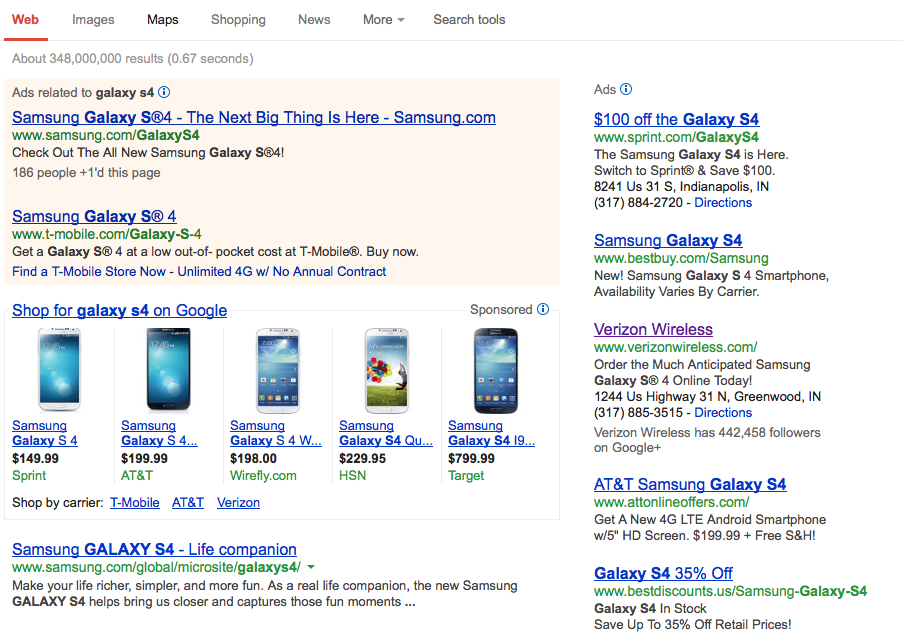
The Federal Trade Commission has sent out a letter to 20 search engines informing them that they are not properly distinguishing the ads in search results from the actual results themselves. Back in 2002, the FTC doubled down on paid listings in search results, forcing search engines to clearly show a difference between the two, but the firm believes that since 2002, companies have fallen back into their old habits. “We have observed a decline in compliance with the letter’s guidance,” the agency said in the letter.
The FTC has now issued new guidelines for search result ads, saying that things such as borders, shading, and text labels must be different when compared to true search results. The agency pointed a finger at Facebook’s new Graph Search feature, saying that “Regardless of the precise form search may take in the future, the long-standing principle of making advertising distinguishable from natural results will remain applicable.” Expand Expanding Close
According to Bloomberg, the FTC is now investigating Google over its Display ad business which it picked up originally in its purchase of DoubleClick almost a decade ago.
The fresh inquiry, which follows the FTC’s decision to close a review of Google’s search business in January without taking action, is in the preliminary stages and may not expand into a larger probe, said the people, who asked not to be named because the matter hasn’t been made public.
FTC investigators are examining whether Google is using its position in U.S. display ads — a $17.7 billion industry that includes the sale of banner ads on websites — to push companies to use more of its other services, a practice that can be illegal under antitrust laws, the people said.
Google today announced in a blog post on its Public Policy Blog that it has asked the Federal Trade Commission and the Department of Justice to investigate and take a stronger stance against patent privateering and patent assertion entities, aka patent trolls. Google linked to a document submitted to the government agencies mentioned above and noted that BlackBerry, Earthlink and RedHat are among other companies backing the request.
Within its post, Google’s Senior Competition Counsel Matthew Bye cited losses of nearly $30 billion a year in the U.S. due to patent trolls and urged companies to help Google create “cooperative licensing agreements that can help curb privateering.”
Trolls use the patents they receive to sue with impunity—since they don’t make anything, they can’t be countersued. The transferring company hides behind the troll to shield itself from litigation, and sometimes even arranges to get a cut of the money extracted by troll lawsuits and licenses.
Google described patent privateering as companies selling “patents to trolls with the goal of waging asymmetric warfare against its competitors.” While it didn’t name any companies specifically in its blog post or document submitted to the FTC, it did link to an article on Bloomberg that mentions Microsoft, Nokia, and Alcatel-Lucent as companies linked to patent privateering.
In the document submitted to the FTC, Google outlined its stance on patent trolls and recommended the FTC initiate an investigation into patent assertion entities and or expand its broader inquiry to include a number of important areas specifically related to patent privateering: Expand Expanding Close
The Federal Trade Commission released a report today that recommends how owners of mobile platforms can better inform consumers about how their data is being handled. The FTC named a number of companies in its report, including: Amazon, Apple, BlackBerry, Google, and Microsoft, as well as “application (app) developers, advertising networks and analytics companies, and app developer trade associations.”
In the report, titled “Mobile Privacy Disclosures, Building Trust Through Transparency,” the FTC issued a number of recommendations. The FTC recommended that all platform owners “Provide just-in-time disclosures to consumers and obtain their affirmative express consent before allowing apps to access sensitive content like geolocation.” It recommended app developers take the same measures in addition to having “a privacy policy and make sure it is easily accessible through the app stores.” The report also suggested that companies implement a ” a one-stop “dashboard” into their operating systems so consumers can easily view how their data is being handled by specific apps.
Other recommendations the FTC asked Apple and others to implement include new icons that “depict the transmission of user data” and a “Do Not Track” option for users to easily opt out of their data being sent to third parties.
“FTC staff strongly encourages companies in the mobile ecosystem to work expeditiously to implement the recommendations in this report. Doing so likely will result in enhancing the consumer trust that is so vital to companies operating in the mobile environment. Moving forward, as the mobile landscape evolves, the FTC will continue to closely monitor developments in this space and consider additional ways it can help businesses effectively provide privacy information to consumers,” the report states.
A full list of the recommendations made by the FTC for mobile platform owners, advertising agencies, and app developers is below: Expand Expanding Close
Jared Polis, U.S. Representative for Colorado’s 2nd congressional district
U.S. Federal Trade Commission officials supposedly want to bring an antitrust case against Google due to complaints about it suppressing competition in the market, but Colorado Rep. Jared Polis cautioned the regulatory body in a letter last week that such a lawsuit would be a “woefully misguided step.”
Many Internet businesses, such as Yelp and Nextag, have criticized Google at open hearings in Congress, asserting Google unjustly applies its search dominance to give web sites lower-quality rankings in search results. The effect would essentially push Internet users toward Google products that provide similar services.
Google has continually rebuffed any wrongdoing, and the Vice President of Engineering Amit Singhal even came to his employer’s defense on the Google Public Policy Blog earlier this summer —in an aggressive tactic not usually taken by the Mountain View, Calif.-based company—to spearhead the rumor-mill accusations in a “claim vs. fact” format.
Democrat Polis specifically wrote in his letter that an anti-trust lawsuit by the FTC would “threaten the very integrity of our anti-trust system, and could ultimately lead to Congressional action resulting in a reduction in the ability of the FTC to enforce critical anti-trust protections in industries where markets are being distorted by monopolies or oligopolies.”
Political newspaper The Hill, which first reported on the letter, further noted that Polis said the market for online search remains adequately competitive despite antitrust complaints:
He noted that customers search Amazon for shopping results, iTunes for music and movies, Facebook for social networking and Yelp for local businesses.
“To even discuss applying anti-trust in this kind of hyper-competitive environment defies all logic and the very underpinnings of anti-trust law itself,” Polis wrote.