In the middle of seemingly stalling profits and a general slowdown of the smartphone industry — like Apple‘s notable first quarter of YoY growth drop in years — Samsung seems to be enjoying a moment of sunshine bathing.
Eleven months after losing the leadership to the Cupertino giant, the Korean manufacturer has climbed once again to the top of the US vendors’ list, as per a Counterpoint Research report (via Business Korea)…
The latest figures from Strategy Analytics show that Chinese brands Huawei and Oppo were the main winners in a year that saw the first ever fall in global smartphone sales, with established brands Samsung and Apple both seeing falls in their share.
Linda Sui, Director at Strategy Analytics, said, “Global smartphone shipments fell 3 percent annually from 345.0 million units in Q1 2015 to 334.6 million in Q1 2016. It is the first time ever since the modern smartphone market began in 1996 that global shipments have shrunk on an annualized basis. Smartphone growth is slowing due to increasing penetration maturity in major markets like China and consumer caution about the future of the world economy.”
While Samsung held its number one place in the rankings, it saw its sales drop by 3.7M year-on-year, while Apple’s iPhone sales dropped by 10M in the same time-frame. It was Chinese brands which picked up these lost sales …
IDC’s latest report is out today with new estimates based on worldwide wearable shipments, and in it is a prediction that Apple Watch will hold the market lead this year and through 2020 as Android Wear begins to close the gap.
While the report shows estimates based on overall wearable shipments, which IDC says will go from 72.2 million last year to 100 million in 2016 for watch and wristband products, it also shows a breakdown of estimates for leading smartwatch platforms by operating system…
According to the latest data from Strategy Analytics, Google’s acclaimed Chromecast streaming dongle made up as much as 35% of the streaming device market in 2015, besting competing devices from Roku, Apple, Amazon, and other manufacturers. Compared to 2014, Chromecast is showing a growing dominance in the market, likely thanks in part to the launch of the 2nd-gen model…
According to the latest U.S. smartphone market share numbers from Parks Associates, Apple is still well in the lead compared to competing manufacturers, holding a beefy 40% of the smartphone market. But the latest figures also show that Android OEMs are gaining ground on the dominant Cupertino, California-based iPhone maker. Now, Samsung holds around 31% of the market and LG is next in line with 10%…
Huawei’s global success over recent months has been well documented. In its homeland it’s just overtaken Xiaomi as the biggest smartphone vendor, and on a global scale it’s only behind Apple and Samsung in terms of shipped devices. Much of that global success, it seems, is due to its performance in Europe where it has multiple devices ranging from low to high end and is shipping them by the bucket load…
In one of the most ambiguous rebuttals of recent memory, Samsung has denied reports claiming it is looking to reduce its workforce by 10%. It’s not reducing its workforce, it says, but “relocating” them. One of Samsung’s high-ranking officials spoke to Yonhap News, claiming that it will “only be relocating workers”, denying rumors that it was looking to move on 10 percent of its management staff in sales and PR. What it didn’t say was what “relocating” actually means, leaving us speculating a number of possible translations for the phrase…
The latest data from Kantar Worldpanel shows that Samsung and Apple continue to dominate the U.S. smartphone market, taking a massive 64% of the total market share between them, and accounting for nine of the ten best-selling models.
If share alone was not enough to demonstrate market dominance, our data also shows that these two vendors sold nine of the top ten best-selling smartphones in the three months ending July 2015 – with LG making a cameo appearance in the ranking.
Android increased its U.S. market share by 1.7% in the 12 months ending in July this year, though dropped 7% in Japan and 4.1% in Europe … Expand Expanding Close
IDC released an updated forecast today lowering its expectations for worldwide smartphone shipments this year with a continuing slowdown of growth in China cited as the biggest contributor to the lower than expected shipments. It also shared some insight into the future of Android, expecting its current 81% share of the global smartphone market as of 2015 to hold strong through 2019, citing continued price sensitivity in the markets with the biggest growth potential (read: China, India, and everyone else in the Asia-Pacific region). Expand Expanding Close
New data from Gartner suggests that Samsung saw its worldwide sales fall by 5.3% year-on-year, its market share dropping from 26.2% in Q2 2014 to 21.9% in the same quarter this year. The company lost ground to both Apple and Chinese brands Huawei and Xiaomi.
Despite the launch of new S6 models, Samsung’s premium phones continued to be challenged by Apple’s large-screen iPhones. Samsung lost 4.3 percentage points in market share and declined 5.3 percent in unit sales in the second quarter of 2015.
Samsung was hit hardest by Huawei, which saw sales growth of 46.3%, followed by Apple, which increased its sales by 36% … Expand Expanding Close
Research firm comScore today released its report on United States smartphone subscriber market share for the three month period ending in June. The report, released monthly, tracks the rankings of the top smartphone OEMs (original equipment manufacturers) and operating systems by consumer adoption. Month-to-month fluctuations in market share aren’t often major, but the data gives us more context around how the top players are doing as we eek towards the 2015 holiday season.
Strategy Analytics has issued its latest estimates of global mobile phone shipments, and reports that Huawei overtook Microsoft (which incorporates the Nokia-designed Lumia) last quarter to become the third-largest mobile phone vendor in the world. The company saw its shipments grow almost 50% to 30.6M units, contrasting strongly with an overall industry growth rate of just 2%.
Ken Hyers, Director at Strategy Analytics, added, “Huawei shipped 30.6 million mobile phones and captured a record 7 percent marketshare worldwide in Q2 2015. Huawei is rising fast in all regions of the world, particularly China where its 4G models, such as the Mate7, are proving wildly popular. Huawei has finally overtaken Microsoft to become the world’s third largest mobile phone vendor for the first time ever.”
The company shared some earnings results earlier this month, showing a 30% increase in revenue and claiming to be on track to hit 100M sales this year.
Samsung retained the number one slot, but saw its market share slip from 22.3% to 20.5% on disappointing Galaxy S6 sales. Samsung earlier revealed an 8% drop in profits, the fifth year running it has reported a decline in profitability …
While Apple’s iPad continues to lead the tablet market, according to new data from IDC, its marketshare has dropped a few points year-over-year, and the overall market for tablets saw negative growth, based on units shipped globally. That’s according to second quarter 2015 unit shipments and marketshare over the same quarter a year ago, as Apple shipped 10.9 million units versus 13.3 million units during the second quarter of 2014. While the iPad continues to lead in the tablet space, IDC’s data shows Apple’s market share dropping nearly 3 points from 27.7% to 24.5%.
Samsung, the number two player in the tablet space, similarly saw declines in both units shipped and market share from Q2 2014 to Q2 2015. The Korean company slipped by a million tablets during the quarter year-over-year, falling from 8.6 million units to 7.6 million units, while its market share dropped a point from 18% to 17% … Expand Expanding Close
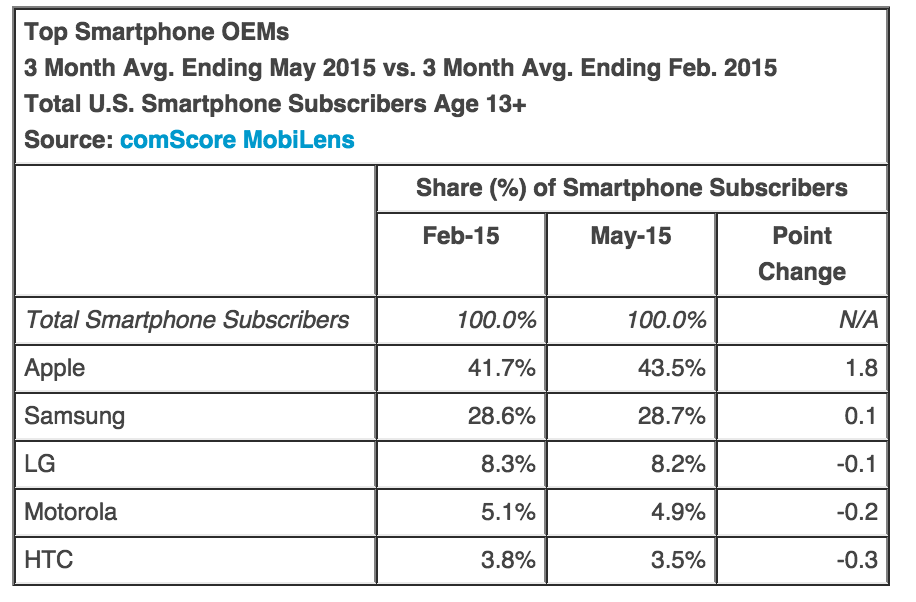
comScore today released its report on United States smartphone subscriber market share for the three month period ending in May. The report, released monthly, tracks the rankings of the top smartphone OEMs (original equipment manufacturers) and operating systems by consumer adoption. Month-to-month fluctuations in market share aren’t typically major, but they can provide a look at how companies’ new flagship smartphones are doing.
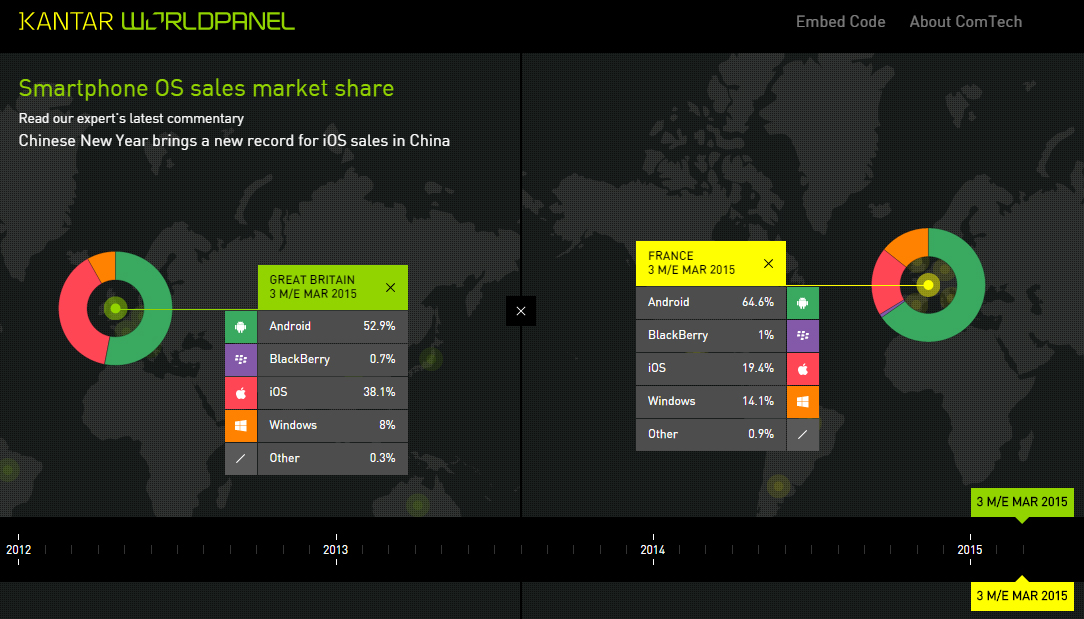
After research firm comScore released data last month indicating that Android’s share of the US smartphone OS market dropped 1 percent during the three months ending in April, Kantar Worldpanel has its own research out which says the OS is gaining momentum stateside again.
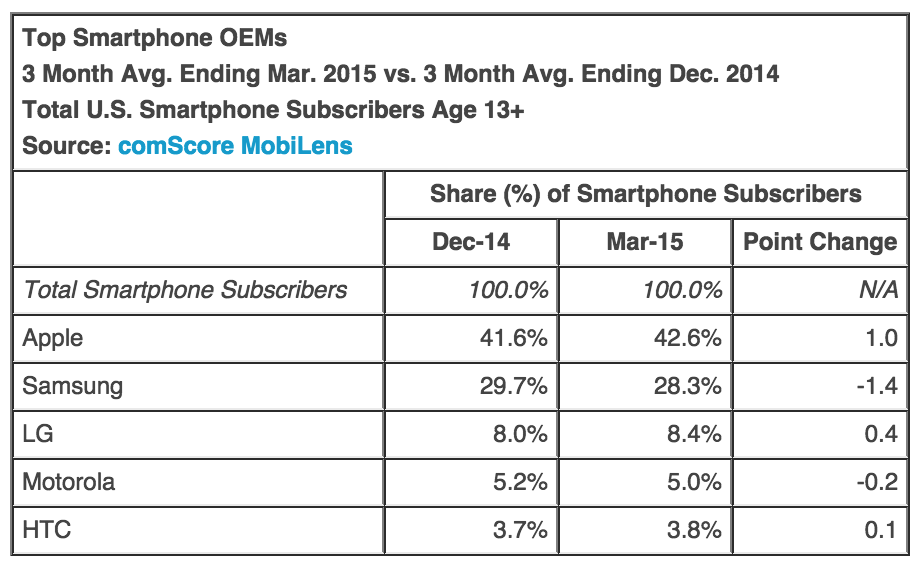
comScore today released a new U.S. smartphone manufacturer and platform market share report for the three month period ending in March. The data suggests that while the continued strength of iPhone 6 adoption has resulted in market share gains for Apple, Android is still the most popular smartphone platform in the United States.
During the measured period, comScore reports that 187.5 million people in the United States owned smartphones, which equates to 77 percent of the total population. Of that, Apple was the most popular OEM (original equipment manufacturer) with 42.6 percent of U.S. smartphone subscribers (up 1% from December), followed by Samsung with 28.3 percent market share (down 1% from December), and LG taking third place with 8.4 percent (up 0.4% from December).
Microsoft’s Bing isn’t the most popular search engine around, but—at least according to the latest from comScore—it’s gaining ground slowly but surely. For the first time, Microsoft sites have surpassed the 20% milestone, meaning more than one fifth of overall search traffic is now owned by the Redmond, Washington company… Expand Expanding Close
IDC just released its latest numbers on the top smartphones by operating system showing Android and iOS continue to collectively dominate the market with both experiencing growth during 2014. Together, iOS and Android grabbed 96.3% of all smartphone shipments, which IDC points out is up from 95.6% in 4Q13 and from 93.8% in calendar year 2013.
According to the latest numbers from IDC, Xiaomi—the rising star of the smartphone industry—has managed to pass up Samsung in China. In 2013, Xiaomi trailed Samsung’s almost 19% market share by a solid 13 percentage points (at just 5.3%), and was only the 5th largest maker of smartphones in China. Things changed in 2014. Last year, Xiaomi finished off with 12.5% of the market, almost a half-point more than Samsung at 12.1%, taking the top spot and passing not just Samsung, but Lenovo, Huawei, and Coolpad as well…
IDC is out today with its numbers on tablet shipments for Q4 2014 showing Apple & Samsung remained on top of the market both last quarter and throughout 2014 despite a slight drop in overall market share.
Apple sold 21.4 million iPads during the holiday quarter last year, which gave the company around 28% market share compared to 33% with 26 million units sold during the same quarter last year. Apple beats out number two Samsung, according to IDC, which grabbed 14.5% of the market in Q4 with 11 million units shipped. Samsung also dipped in overall market share from 17.2% with 13.5 million units shipped in the year ago quarter. Expand Expanding Close
We noted 18 months ago that Android could be on track to ship a billion devices in 2014, tablets included, and Strategy Analytics has just revealed that the tablets weren’t needed: more than a billion Android smartphones were sold last year.
Android shipped 1.0 billion smartphones worldwide in 2014, rising from 0.8 billion units in 2013. Android has become the first ever smartphone operating system to ship more than 1 billion units in a single year. Android accounted for a huge 81 percent share of all smartphones shipped globally in 2014.
Putting the number at 1.0427B handsets, the research company said that emerging markets like China were key to the growth. The figures show that the Android smartphone market has doubled in size since 2012 … Expand Expanding Close
Chinese manufacturer Huawei has announced record-breaking results for 2014, with smartphone sales up 45% to 75 million and revenue up 30% to $12.2B. The numbers aren’t too great a surprise, as Reuterscame pretty close to calling them in a piece posted on New Year’s Eve.
The dramatic growth in sales could see Huawei threatening the rankings of both LG and Xiaomi in the next round of market share estimates after recently being knocked down into fifth place …
The latest numbers from Strategy Analytics reveal that Android was installed on over 8 of 10 smartphones worldwide in the third quarter, as the mobile operating system captured 84% global market share for the three-month period ending September. That figure arrives just one day after the research firm reported that Chinese company Xiaomi has become the third-largest smartphone maker in the world.
Android continued to be a dominant player in global smartphone operating system market share, increasing its lead over iOS by three percentage points compared to the year-ago quarter. Apple’s mobile operating system held 12.3% market share during the third quarter, trailed by Windows Phone (3.3%) and BlackBerry (0.7%). Other mobile platforms accounted for less than 0.1% market share. Expand Expanding Close