Android

See All Stories

Breaking news for Android. Get the latest on apps, carriers, devices, and more!
Android is Google’s mobile operating system, launched in September 2008, although its history technically began with the release of the Android alpha in November 2007. To this day, Android powers the majority of the world’s smartphones and comes in several different flavors across many phone makers.

What is Android?

Android Inc.

Android, before it was Android, was a company called Android Inc. That company was founded in Palo Alto, California, in 2003 by a crew of four: Andy Rubin, Rich Miner, Nick Sears, and Chris White. The company and its project was acquired by Google in 2005 for a sum of more than $50 million, although the exact number is unknown. The company’s founders joined Google as part of the deal.

In its infancy, Android was an operating system built not for touch screen smartphones like the iPhone, but rather BlackBerry-like devices with physical keyboards. It’s well documented that after Apple shocked the world with the iPhone, ahead of its nearest competition by at least a couple years, Google and Android Inc. had to go back to the drawing board to build something competitive.

Adoption by third-party makers

It didn’t take long after the launch of the iPhone for various manufacturers to enter the market with their alternatives — and Google’s Android immediately became the obvious platform of choice for just about everyone except Microsoft. HTC was the first manufacturer on board, and introduced the T-Mobile G1 running Android in September 2008. Soon after, HTC, Motorola, Samsung, and carriers like Sprint and T-Mobile jumped on board to form the Open Handset Alliance.

Android makers across the world

Iconic Android handsets

There have been thousands of Android phones released since Android’s inception, but some have been more important to the platform’s history than others. There was the original T-Mobile G1, as mentioned, but there was also the HTC One Google Play Edition, Moto G, Samsung Galaxy S4, and others. Some of the most iconic Android handsets include:

  • HTC G1
  • HTC Nexus One
  • Samsung Galaxy S, S2, S3, S4, and their successors
  • HTC Incredible S
  • Samsung Nexus S
  • Samsung Galaxy Nexus
  • Samsung Galaxy Note
  • Nokia 8
  • BlackBerry KeyOne
  • Google Pixel and its successors

In more modern times, there are several Android smartphones makers that popped up across various niches and in several international markets. Huawei is a dominant Android maker in China and many European markets, while Samsung is by far the most popular maker in the United States by far — effectively creating a duopoly with Apple. Today, there are dozens of major device makers contributing to the Android ecosystem.

Full list of Android OEMs

History of major Android versions

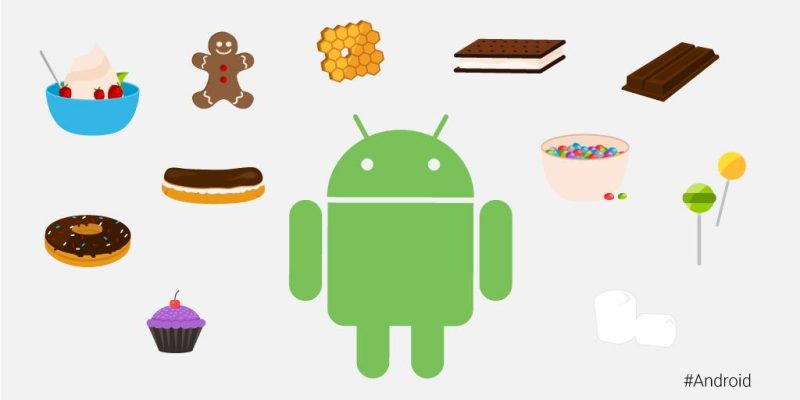
Android has seen countless software revisions over the course of its life, but in modern times the OS usually sees a major release on an annual cadence. In the earlier days, Google famously gave its major software releases dessert-themed codenames, but retired that practice in 2019 with the release of Android 10.

VersionNameReleaseDevices
2.3GingerbreadFebruary 9, 2011Nexus S
4.0Ice Cream SandwichOctober 19, 2011Galaxy Nexus
4.1Jelly BeanJuly 9, 2012Nexus 7
4.2Jelly BeanNovember 13, 2012Nexus 4, 10
4.3Jelly BeanJuly 24, 2013Nexus 7 (2013)
4.4KitKatOctober 31, 2013Nexus 5
5.0LollipopNovember 3, 2014Nexus 6, 9
5.1LollipopMarch 9, 2015Android One
6.0MarshmallowOctober 5, 2015Nexus 5X, 6P
7.0NougatAugust 22, 2016Nexus 5X, 6P
7.1NougatOctober 4, 2016Pixel, Pixel XL
8.0OreoAugust 21, 2017Pixel, Pixel XL
8.1OreoDecember 5, 2017Pixel, Pixel XL
9PieAugust 6, 2018Pixel 2, Pixel 2 XL
1010September 3, 2019Pixel 3, 3a
1111September 8, 2020Pixel 4

List of major Android OS platforms

While Android proper is certainly the most widespread of Google’s Android operating systems, the company has also launched many offshoots of the main OS over the years. There’s Android Auto, Android Wear (now Wear OS), Android TV (now rebranded to Google TV), as well as versions of Android built for tablets and Android Things (now defunct).

HERE offline map app arrives on Android for the first time, initially on Samsung Galaxy phones only

Site default logo image

HERE, the competitor to Google Maps initially available only on Windows Phone, has arrived on Android for the first time. Initially, the beta version of the Android app will be limited to Samsung Galaxy smartphones.

The main claim to fame of the app is that it offers the ability to download entire regions or countries for offline use, in contrast to Google Maps which only allows you to cache areas you have viewed while online. HERE maps currently cover around 200 countries, though turn-by-turn directions are so far limited to about half of these … 
Expand
Expanding
Close

Site default logo image

Verizon repackages the Motorola RAZR M as its $200 prepaid Luge

Verizon has quietly repackaged one of our favorite little smartphones as its latest prepaid offering. The RAZR M released almost two years ago as a budget-friendly LTE handset and it’s now being rebranded as the Motorola Luge, with a $200 off-contract price tag. Maybe Verizon is trying to clear out its old inventory while marketing its new prepaid LTE services, because other than a name and software change, this handset is pretty much what the carrier released two Septembers ago.


Expand
Expanding
Close

Microsoft, Amazon, others reportedly eyeing Cyanogen for future smartphone software

CyanogenMod—which is probably the most well-known fork of Android—lets users customize their phone beyond what Google intends, and touts having as many as 12 million active installs across a variety of devices. But the company behind the famed alternative operating system is reportedly getting a lot of attention, notably from companies that would consider themselves some of Google’s biggest rivals.


Expand
Expanding
Close

Motorola’s Yo-based Moto 360 giveaway went exactly as planned

Motorola recently concluded a giveaway for its upcoming Moto 360. The giveaway was a collaboration between Motorola and Yo app which was announced yesterday with a very simple rule. First, download and install Yo on your device, then send Motorola a Yo and wait until Aug. 28, 2014 at 3:00 p.m. CT. Easy enough, right?

Motorola would then send a Yo link to all entrants and the first 20 people to click the link would win a Moto 360. Well, that’s kind of how it seemed, but that wasn’t actually the case. Motorola successfully sent a Yo link to all who initially entered, but it was a bit more complicated than just clicking a link.


Expand
Expanding
Close

Sprint rolling out free international WiFi calling to the US, Puerto Rico and US Virgin Islands

Site default logo image


Today, Sprint announced a new international WiFi calling option that lets its customers place calls to the US, Puerto Rico and the US Virgin Islands from over 100 countries at no additional charge. The new feature is now available to Samsung Galaxy S4 owners via an over-the-air software update, however Sprint says that support will come to other devices throughout the year.


Expand
Expanding
Close

In-Depth profile of Motorola tracks its rise and fall (and future)

Site default logo image

If you want to learn what happened behind the scenes in the tumultuous world of Motorola in the past decade, Chicago Mag does an excellent in-depth feature of the company that is awaiting approval of its sale from Google to Lenovo. Some excellent bits:

Meanwhile, in arguably one of the worst decisions ever made by a major corporate CEO, Zander struck a deal with his Silicon Valley friend Steve Jobs, the CEO of Apple. Together their companies created a Motorola iTunes phone, the first phone connected to Apple’s music store. “We can’t think of a more natural partnership than this one with Apple,” Zander said at the time. Named the Rokr, the phone launched in the fall of 2005. Jobs, who introduced it, called it “an iPod Shuffle right on your phone.”

Ouch, a Shuffle…
Expand
Expanding
Close

Sprint announces visual voicemail w/ animated avatars for select Android phones

Site default logo image

Sprint announced today that it’s rolling out an enhanced visual voicemail feature to select Android devices that introduces avatars for “personalized voice messages that feature talking characters (including animals, aliens, zombies and sock puppets), scenic backgrounds and voice effects.” The feature will also be available to Boost Mobile and Virgin Mobile USA customers.
Expand
Expanding
Close

Huawei Ascend Mate 7 spotted in the wild before its IFA reveal

Site default logo image

Huawei is set to unveil its new Ascend Mate 7 next week during IFA in Berlin, however the unreleased phone appears to have been spotted in the wild prior to its big showing. A device referred to as the Chinese phone maker’s next handset recently made a cameo appearance on the Asian microblogging site Weibo, revealing a phone that is somewhat reminiscent of the HTC One Max.


Expand
Expanding
Close

Motorola giving away 20 Moto 360 smartwatches via Yo contest

Site default logo image

Motorola is expected to finally unveil its circular Moto 360 smartwatch at a press event on September 4th. We already know a lot about the device, but two key details that are missing are the price and release date. This afternoon, however, the company announced that it is giving 20 people an early chance at winning a Moto 360.


Expand
Expanding
Close

HTC’s mid-range Desire 510 is coming to Cricket, Sprint, Virgin and Boost Mobile

Site default logo image

HTC is mostly known for its high-end devices that are built with premium materials, however the Taiwanese electronics manufacturer is starting to make a splash in the mid-range smartphone space. Today, the company announced the launch of the Desire 510, a new budget-friendly LTE-capable phone that’s coming to Sprint, Cricket, Virgin and Boost Mobile in the coming months.


Expand
Expanding
Close

Site default logo image

AT&T’s HTC One M8 finally receives its Android 4.4.3 update

Android 4.4.4 might be one of the final KitKat releases before Google moves its mobile operating system to version L, but that doesn’t mean that everyone is happily riding on the new software bandwagon. After waiting what probably felt like an eternity, the HTC One M8 on AT&T is finally getting a taste of Android 4.4.3. Sure, it’s not the latest and greatest software that Mountain View has to offer, but today’s update does manage to ship with its share of enhancements.


Expand
Expanding
Close

Site default logo image

LG teases new round smartwatch one more time ahead of its IFA debut

LG is going to announce a round smartwatch next week during IFA in Berlin and to keep its hype train chugging along, the company has shared a new teaser image of its next timepiece on its Facebook page. Captioned with the tagline “smart comes full circle,” the photo shows a shadowy image of what looks like a round watch face that almost looks metallic.


Expand
Expanding
Close

Pandora Internet Radio lands on Google Glass

Site default logo image

Pandora Internet Radio is the latest service to bring its product over to the Google Glass world. The music streaming service’s Glassware app came out of their Hack-a-thon from earlier in the spring, Pandora says, and was good enough to share with Google and ship.

The Pandora Radio app for Google Glass gives users access to stations with the ability to control them with voice commands or the touchpad. Pandora says the voice commands allow you to select existing stations or even create new stations. Actions including music controls like play and pause require using the touchpad; favoriting and dismissing a track also requires using the touchpad for now.

Users can find the Pandora Internet Radio app on the Google’s Glassware section, and Pandora has more instructions below:
Expand
Expanding
Close

Site default logo image

Samsung shares two more Galaxy Note teasers ahead of Note 4 unveiling (Videos)

[youtube=http://youtu.be/Z42CZr4-qWg]

Samsung has released a handful of new ads for its Galaxy Note product line over the last week, which isn’t much of a surprise considering its expected to unveil a brand new “Note 4” at IFA early next month. We previously shared two of the ads that focused on handwriting and some of the other unique features of the device, and today Samsung has posted another two spots (above and below) that profile two normal Galaxy Note users and how they use the device on a day-to-day basis.

As always, the Note spots highlight features like the device’s S Pen stylus and the larger, phablet size screen. This time, Samsung also mentions that the Note 4 is coming out soon towards the end of the ads.

We’ll be on hand at IFA in Berlin early next month to bring you all the latest live from Samsung’s event. Head below for the second ad:

[youtube=http://youtu.be/i8WjKvHMkDo]

Dropbox dramatically cuts pricing to compete, 1TB now just $9.99/month

Site default logo image

Dropbox has today slashed its pricing and doubled the maximum storage space from 500GB to 1TB. Up until yesterday, you’d have been paying $500/year for 500GB; today you can pay just $120/year (or $99/year when paying annually) for a terabyte.

The new deal finally brings Dropbox into line with Google Drive and Microsoft OneDrive, with Apple’s new iCloud pricing – which includes iCloud Drive – also looking to be broadly similar … 
Expand
Expanding
Close

Samsung champions metal frame, curved corners & finish of Galaxy Alpha in new blog post

Site default logo image

[youtube=https://www.youtube.com/watch?v=-_I4Ab_LdxQ]

Samsung has put together a blog post extolling the virtues of the metal frame, curved corners and finish of the handset it created to go head-to-head with Apple’s iPhone, the Galaxy Alpha. It follows an earlier post on the making of the phone.

The prose is best described as stilted, but the general idea is that every element of the design has a reason behind it. Metal, we are told, offers “thinness, style and a comfortable grip.” And just in case anyone should accuse them of copying the iPhone in switching from plastic to metal, Samsung is quick to point out it started making metal phones back in 2006 – a year before the first iPhone … 
Expand
Expanding
Close

Talking Schmidt: Know your competition, but don’t copy it

Site default logo image

“Know your competition, but don’t copy it.” Those words of wisdom come from the image above accompanying a message put on the entirely original – not a copy of Facebook – Google+ by Google executive chairman and former CEO Eric Schmidt. Schmidt is promoting his new book with Jonathan Rosenberg called How Google Works due out next month where the billionaire lays out the principles that made Google what it is today.

Included with the lemonade stand image and ‘don’t copy’ caption is another Schmidt line on originality and competition. “Playing catch-up with the competition will never help you get ahead by creating something new,” Schmidt says. Google would be the “hard” boozy lemonade to the competitions’ fresh lemonade. In the case of Google Plus, the booze could be the hangouts or perhaps the photo editing features or integration with other Google products.

Now picture this tidbit from Walter Isaacson’s biography of the late Apple CEO and co-founder Steve Jobs:

“I will spend my last dying breath if I need to, and I will spend every penny of Apple’s $40 billion in the bank, to right this wrong,” Jobs said. “I’m going to destroy Android, because it’s a stolen product. I’m willing to go thermonuclear war on this.”

It’s hard to deny that Android started looking a lot more like iOS after the iPhone’s introduction, and iOS has clearly borrowed its fair share of features from Google’s mobile operating system, but there’s no denying that Schmidt’s message could be challenged. File this one with the rest under Talking Schmidt.