Twilio integrates with Google Cloud Platform to bulk Google App Engine with voice and messaging services

Screen Shot 2013-04-02 at 9.53.40 AM

Twilio, a voice and messaging API solution, announced a partnership with Google’s Cloud Platform today.

Twilio is the first of its kind to integrate with Google App Engine and give developers voice and messaging services for their apps with just a few lines of code, and its APIs are priced on a pay-per-use scale, as first noted by TechCrunch. Voice services like making calls, for instance, start at 2 cents per minute, and the ability to receive calls costs just $1 per phone number and 1 cent per minute.

“We’re very excited to partner with Google to be the first voice and messaging platform integrated with Google Cloud Platform,” explained Twilio on its blog, while also listing step-by-step instructions on how to register with Google App Engine, build a messaging app, etc.

Twilio’s SDK notably includes one-to-one voice and messaging, SIP support, in-app conference calling, group texting, two-factor authentication, phone numbers, and mobile app distribution. Hipmunk, for instance, uses Twilio’s distribution feature to supply users with a text message and link to download its app.

Read more

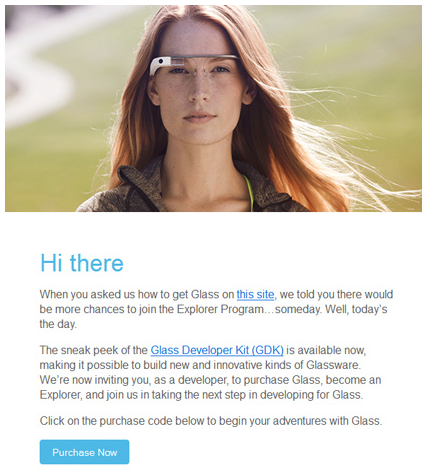
Head of Google Glass Babak Parviz talks what is next for the platform

glass_photos

As 2013 kicks off, Babak Parviz, head of the Google Glass project that launched in spring of last year, sat down in an interview with IEEE Spectrum to give word on what to expect next.

We saw several prototype versions of Google Glass, as it readies shipping to the mainstream, and today, Parviz gave some insight into what has changed. “We constantly try out new ideas of how this platform can be used. There’s a lot of experimentation going on at all times in Google,” said Parviz. “We’re also trying to make the platform more robust. This includes making the hardware more robust and the software more robust, so we can ship it to developers early this year.” The early 2013 shipping time was announced at Google I/O 2012. It is nice to see Google is still on-track; however, new features for the platform have not been revealed. “The feature set for the device is not set yet. It is still in flux,” Parviz said.

Parviz also covered how Google will make a business out of Google Glass, and, maybe as a surprise to many, the Mountain View company currently doesn’t have plans to include advertising—its bread and butter. The business model is still being worked on: “This is still being worked on, but we are quite interested in providing the hardware…At the moment, there are no plans for advertising on this device.”

Other revelations in the interview include a cloud-based API so developers can integrate their Android apps into Google Glass. An example given was email and calendar services. Lastly, Parviz said the Glass team has worked hard on battery life and making sure the device is safe on the eyes. You can read the full interview for more. [IEEE Spectrum] Read more

Google sponsors ‘Reroute/sf’ Hattery Labs hackathon with $10K in prizes for best innovation using Google Maps API


Google is sponsoring an upcoming hackathon by Hattery Labs that is awarding two grand prizes to innovators using Google Maps API.

The “Reroute/sf” hackathon runs from Oct. 19 to Oct. 21 at The Hattery, according to its Facebook page, and it aims to “improve transportation in San Francisco with technological innovation, and work with the City to make it real.” The three-day event essentially invites engineers, designers, and entrepreneurs to “make San Francisco a better place.”

The hackathon will host three challenges, i.e., “Collect the right data,” “Plan a trip anywhere – on-time,” “See what’s broken and watch it get fixed,” while senior representatives from the City of San Francisco and the technology community will determine who wins the following four prizes:

  • Best Innovation using Google Maps API | $7,500 Grant
  • Runner-up Innovation using Google Maps API | $2,500 Grant
  • Best Public Transit Innovation | $500 Clipper Card credit
  • Best Collaboration | 3 free General Assembly classes per team member

Aside from Google, the Hattery, the San Francisco Mayor’s Office, San Francisco Municipal Transportation Agency, Waze, Google Maps, and the General Assembly sponsor the hackathon. The Hattery is a collection of experts ranging from designers and engineers to investors and brand marketers, and some of their most notable collaborative work under Hattery Labs includes giving people clean water and helping Haitians rebuild schools through WellDone and Haiti School Project, respectively.

Registration details below.

Read more

German court rules Motorola does not infringe Microsoft patent

According to the Mannheim Regional Court in Germany, Motorola Mobility does not infringe on a Microsoft patent enabling a “method and radio interface layer comprising a set of application programming interfaces (APIs).” The patent, which Reuters described as allowing “applications to work on different handsets,” is considered a rare victory for Google’s Motorola. Throughout its countersuits, Microsoft has been able to win three patent cases against Motorola in Germany. As noted by Microsoft-funded blogger Florian Mueller, “Microsoft should actually thank Motorola for this initiative, which at this stage has been far more productive for Microsoft than for Google.”

Microsoft is expected to appeal the decision, as usual, but the Judge Voss did not go over the reasoning behind the ruling during the announcement. Microsoft’s associate general counsel David Howard provided a statement to Reuters:

Read more

Discover is the first to implement Google’s ‘Save to Wallet’ API, makes adding cards easier

Google rolled out its Google Wallet web app at the beginning of the month and introduced support for all major credit cards, including Visa, MasterCard, America Express, and Discover, at the same time. Today, the company announced on the Google Commerce blog that Discover Card is the first to implement the new “Save to Wallet” API for credit and debit card issuers.

Discover securely transmits all required information directly to Google Wallet. You can then select your Discover Card to be the primary method the Google Wallet app will use for in-store purchases, or when shopping online from Google Play or other merchants that accept Google Wallet. You’ll continue to earn rewards on every purchase you make. Discover has also provided Google Wallet with card imagery for the Discover More® Card, so you can easily identify your virtual Discover card in your mobile wallet.

Google demoed the new API during its full Wallet session at Google I/O in June. The feature allows card issuers and eventually other partners to provide a “Save to Wallet” or “Add Your Card” option in their website or application to securely transfer card and account information to Google Wallet. Google said the API would eventually extend to saving Offers in addition to payment cards.

To save a Discover Card to Google Wallet, follow the instructions below:

Read more