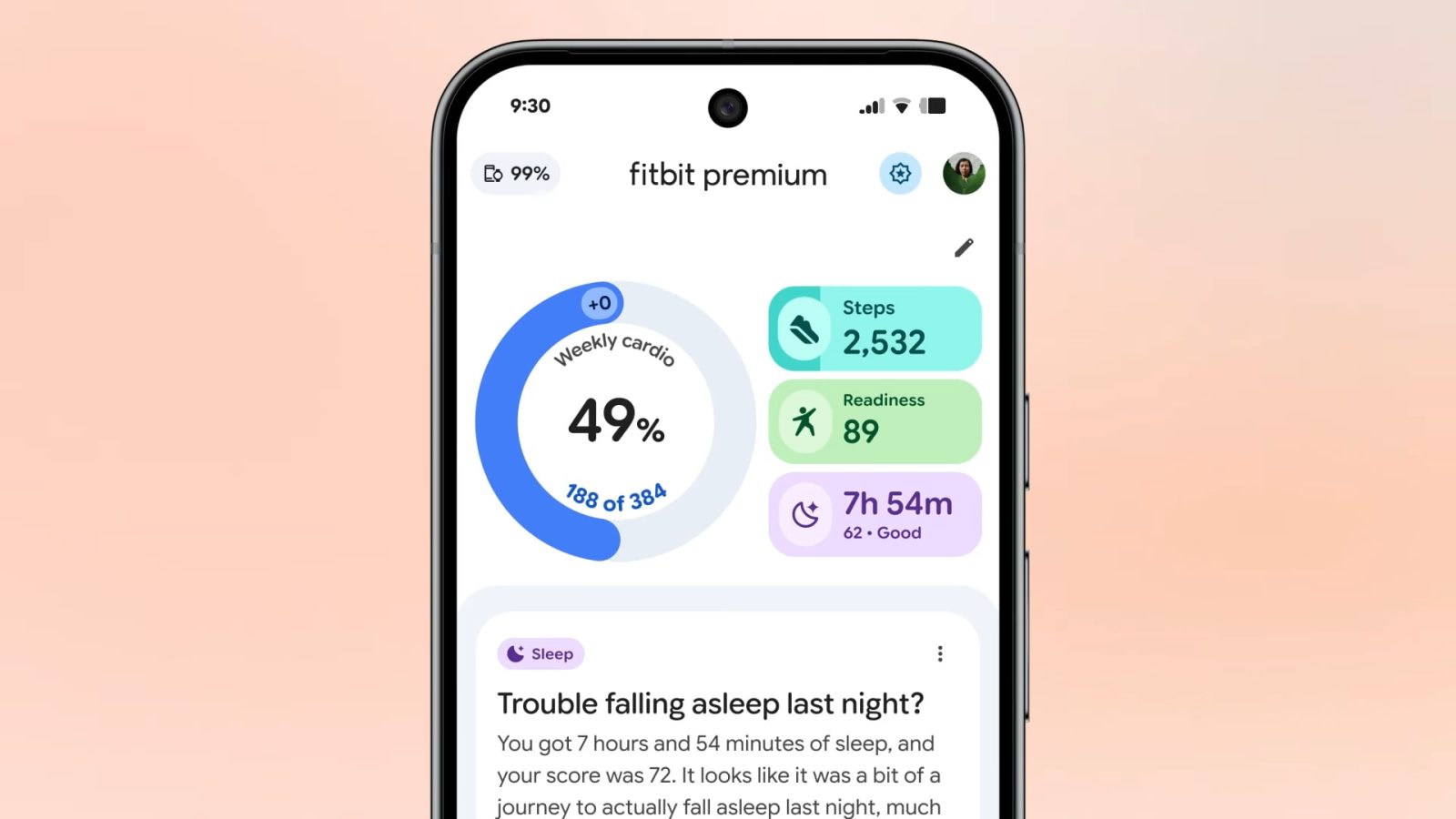
Fitbit Public Preview adds food & water logging, more as app redesign comes to free users



AI companies in California are getting a tighter leash with a new open-ended bill that aims to add some restraints to how the new business model category can operate in the state. The bill affects a large majority of AI development companies.
Expand Expanding Close

Microsoft is no stranger to AI in the public eye. The company’s Bing Chat is widely accepted as a success built off the work of ChatGPT. To widen out a bit, the Microsoft Store is also getting an AI solution that will bring categorized apps and AI-generated feedback for developers.
Expand Expanding Close

Machine learning inherently requires large amounts of data to work and draw patterns. In recent years, there has a been a push to ensure the information used remains private. Google today announced an open source differential privacy library that its own products use.

We previously reported that Google was having “issues” with its newly created AI ethics board as a result of controversy surrounding certain board members. In a Vox exclusive, Google has since confirmed that they have dissolved the AI ethics board having barely managed a full week.
Ahead of the 2019 TensorFlow Dev Summit, Google is announcing a new way for third-party developers to adopt differential privacy when training machine learning models. TensorFlow Privacy is designed to be easy to implement for developers already using the popular open-source ML library.
At Cloud Next 2019 last July, Google announced grammar suggestions for Google Docs in early beta. Google is today rolling out the web feature to paid G Suite Basic, Business, and Enterprise customers.
For the past three years, Google and Verily have leveraged machine learning to screen for the two leading causes of preventable blindness in adults. In India, this algorithm is now being used in a clinical setting, while the European Union has certified it as a medical device.
Following a resounding Go victory in 2017, Alphabet’s DeepMind turned to conquering StarCraft II. The game is a “grand challenge” for how successful AI agents are at complex tasks, with DeepMind and Blizzard tomorrow live streaming a demonstration of the latest progress.
Google employees last year organized in protest against a machine learning project with the U.S. military to analyze drone footage. Googlers were successful in halting Project Maven and the company created AI Principles to govern future products. Those 4,000 anonymous Googlers have today been named the 2018 Arms Control Persons of the Year.

The Play Store has a problem with spam, there’s no way around it. With causes ranging from apps that borderline beg users for reviews and companies that pay for fake reviews, it’s obvious something needed to be done. This year, Google has acknowledged all the spam and finally has begun to do something about it by creating a machine-learning-powered anti-spam system to remove fake reviews from the Play Store.
With the Machine Learning Crash Course earlier this year, Google published its internal boot camp to expose AI to everyone. The company is now partnering with colleges across the U.S. to teach machine learning to students that have already taken computer and data science courses.

We haven’t done a Talking Schmidt in a while, not because the former Google CEO and current Alphabet Board member Dr. Eric Schmidt has been quiet with his sometimes outlandish commentary, but because of his reduced role at Google and its now parent company Alphabet. In February Schmidt stepped down as Chairman, taking an innovation role at MIT and was replaced by John Hennessy.
But back to the matter at hand…
Since news emerged in March that Google was working with the U.S. military to use machine learning to analyze drone footage, some employees have been debating and protesting the decision. Many Googlers have expressed discontent through a petition, while others are now beginning to quit over the matter.
Federated learning is not a new concept in the tech industry with Google exploring it for Gboard last year. However, ahead of I/O, the company has published a new video that provides a good recap of its benefits, possibly suggesting a broader push at tomorrow’s keynote.
Following last week’s Q1 2018 earnings, Alphabet has published its annual Founders’ Letter. Penned this year by Sergey Brin, it traditionally serves as an update on current progress and charts the company’s future. In 2017, machine learning is unsurprisingly the overarching narrative.
Machine learning has the potential to fuel major technological developments in countless fields, with Alphabet’s X division already investigating agriculture and food production usage. A team inside Google is now using it for cancer research and detection with a prototype microscope.
One particular advancement driven by machine learning is the ability for computers to understand natural language, with Google showcasing these improvements with Smart Reply. Its Research division has been exploring other applications and today releasing two fun and interesting demos.
News emerged last month of a Google partnership with the U.S. military on machine learning to analyze drone footage. This set off a fierce internal debate among employees, but it appears that the company is continuing with plans to win lucrative contracts.


Shortly after word broke that Google was working with the Department of Defense on open-source software to help analyze drone footage, employees began forwarding along a petition internally asking Sundar Pichai to end participation in the project. Additionally, the letter asks that Google bans all future “warfare technology.”
Do you think Google should avoid working with the military or providing open-source software for the government?
Last month, a report revealed that Google was partnering with the Department of Defense on machine learning to analyze drone footage. This project caused an uproar within the company, with Googlers circulating a letter asking Sundar Pichai to drop the project and ban future “warfare technology.”
The next moonshot for Alphabet’s X division might be in agriculture as it investigates how to apply artificial intelligence to food production. While in its early days, Astro Teller revealed that the research division is also interested how drones and robotics could be leveraged.
Google is not only applying machine learning across its products, but also encouraging other developers to adopt it in third-party services and other use cases. It has now emerged that one of the latter examples is for drones from the U.S. government.
With the 2018 World Economic Forum underway in Davos, Switzerland, Sundar Pichai took to the stage for a one-on-one interview. Artificial intelligence and its impact were unsurprisingly big areas of discussion, with the Google CEO offering ways to mitigate risks. Meanwhile, data and taxes were also brought up.


Google claims that the latest version of its AI-powered speech synthesis system, Tacotron 2, is almost indistinguishable from human speech – and has put some comparative examples online to demonstrate.
Tacotron 2 works directly from written text, and Google says it can use context to correctly pronounce identically-spelled words like ‘read’ (to read) and ‘read’ (has read), responds to punctuation and can learn to stress words …


