Android

See All Stories

Breaking news for Android. Get the latest on apps, carriers, devices, and more!
Android is Google’s mobile operating system, launched in September 2008, although its history technically began with the release of the Android alpha in November 2007. To this day, Android powers the majority of the world’s smartphones and comes in several different flavors across many phone makers.

What is Android?

Android Inc.

Android, before it was Android, was a company called Android Inc. That company was founded in Palo Alto, California, in 2003 by a crew of four: Andy Rubin, Rich Miner, Nick Sears, and Chris White. The company and its project was acquired by Google in 2005 for a sum of more than $50 million, although the exact number is unknown. The company’s founders joined Google as part of the deal.

In its infancy, Android was an operating system built not for touch screen smartphones like the iPhone, but rather BlackBerry-like devices with physical keyboards. It’s well documented that after Apple shocked the world with the iPhone, ahead of its nearest competition by at least a couple years, Google and Android Inc. had to go back to the drawing board to build something competitive.

Adoption by third-party makers

It didn’t take long after the launch of the iPhone for various manufacturers to enter the market with their alternatives — and Google’s Android immediately became the obvious platform of choice for just about everyone except Microsoft. HTC was the first manufacturer on board, and introduced the T-Mobile G1 running Android in September 2008. Soon after, HTC, Motorola, Samsung, and carriers like Sprint and T-Mobile jumped on board to form the Open Handset Alliance.

Android makers across the world

Iconic Android handsets

There have been thousands of Android phones released since Android’s inception, but some have been more important to the platform’s history than others. There was the original T-Mobile G1, as mentioned, but there was also the HTC One Google Play Edition, Moto G, Samsung Galaxy S4, and others. Some of the most iconic Android handsets include:

  • HTC G1
  • HTC Nexus One
  • Samsung Galaxy S, S2, S3, S4, and their successors
  • HTC Incredible S
  • Samsung Nexus S
  • Samsung Galaxy Nexus
  • Samsung Galaxy Note
  • Nokia 8
  • BlackBerry KeyOne
  • Google Pixel and its successors

In more modern times, there are several Android smartphones makers that popped up across various niches and in several international markets. Huawei is a dominant Android maker in China and many European markets, while Samsung is by far the most popular maker in the United States by far — effectively creating a duopoly with Apple. Today, there are dozens of major device makers contributing to the Android ecosystem.

Full list of Android OEMs

History of major Android versions

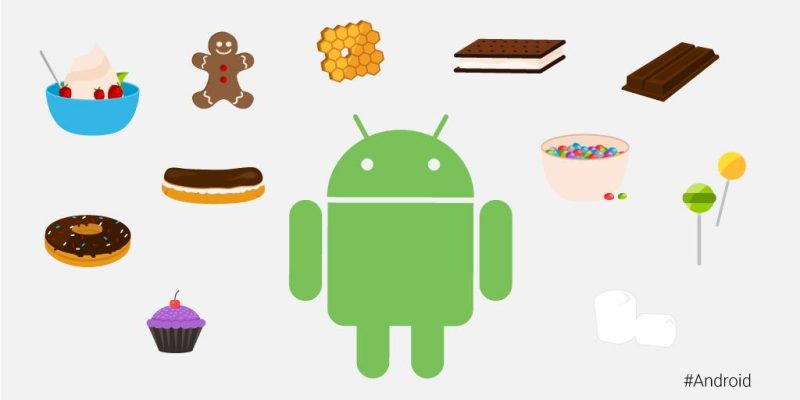
Android has seen countless software revisions over the course of its life, but in modern times the OS usually sees a major release on an annual cadence. In the earlier days, Google famously gave its major software releases dessert-themed codenames, but retired that practice in 2019 with the release of Android 10.

VersionNameReleaseDevices
2.3GingerbreadFebruary 9, 2011Nexus S
4.0Ice Cream SandwichOctober 19, 2011Galaxy Nexus
4.1Jelly BeanJuly 9, 2012Nexus 7
4.2Jelly BeanNovember 13, 2012Nexus 4, 10
4.3Jelly BeanJuly 24, 2013Nexus 7 (2013)
4.4KitKatOctober 31, 2013Nexus 5
5.0LollipopNovember 3, 2014Nexus 6, 9
5.1LollipopMarch 9, 2015Android One
6.0MarshmallowOctober 5, 2015Nexus 5X, 6P
7.0NougatAugust 22, 2016Nexus 5X, 6P
7.1NougatOctober 4, 2016Pixel, Pixel XL
8.0OreoAugust 21, 2017Pixel, Pixel XL
8.1OreoDecember 5, 2017Pixel, Pixel XL
9PieAugust 6, 2018Pixel 2, Pixel 2 XL
1010September 3, 2019Pixel 3, 3a
1111September 8, 2020Pixel 4

List of major Android OS platforms

While Android proper is certainly the most widespread of Google’s Android operating systems, the company has also launched many offshoots of the main OS over the years. There’s Android Auto, Android Wear (now Wear OS), Android TV (now rebranded to Google TV), as well as versions of Android built for tablets and Android Things (now defunct).

Instagram is quietly testing a major visual overhaul of its Android app

Site default logo image

Instagram, following the controversial announcement that it would change the order in which images appear in user feeds, now appears to be testing a complete redesign of its app. Instagram has long stuck to the same skeuomorphic design, but if this redesign rolls out to everyone, the app could finally move forward and fall into line with the design trends being adopted by many other apps.


Expand
Expanding
Close

Android Studio 2.1 with support for N Developer Preview released to stable channel

Along with the Android N Developer Preview, Google released a preview version of Android Studio to allow developers to begin testing their apps. Android Studio 2.1 has now been released to the stable channel with updates to Instant Run, along with other Android N development features.


Expand
Expanding
Close

Google is now selling ‘snap-and-swap’ MODE watch bands for Android Wear [Video]

Site default logo image

After just a bit of teasing yesterday, Google is now offering some “snap-and-swap” MODE watch bands for a variety of Android Wear devices. While the MODE web pages and Google Store landing pages offering more details have yet to launch (Update: Now they’re live!), the video Google published today suggests that there will be many varieties available on the Google Store, Amazon, and Best Buy…


Expand
Expanding
Close

Nokia is buying popular healthcare accessory/app maker Withings

Nokia announced today plans to purchase Withings, maker of many popular healthcare related accessories and companion apps for Android smartphones and other mobile devices.

The company said the 170 million Euro purchase would see Withings become part of its Nokia Technologies business and help jump-start its new efforts at Digital Health products.


Expand
Expanding
Close

Samsung will show off five weird and wonderful C-Lab gadgets at its developer conference this week

Samsung has announced that it will show off five experimental projects from its C-Labs group during the Samsung Developer Conference at Moscone West Center from April 27th to 28th in San Francisco. Among them is LiCon, an app that can recognize various IoT devices using a camera and download remote controls for them, plus a few other weird and wonderful gadgets.


Expand
Expanding
Close

Android 6.0 Marshmallow update for BlackBerry PRIV being rolled out from today

After a few weeks testing the software with a select group of beta participants, BlackBerry is finally rolling out the Android Marshmallow update for the PRIV from today. It comes with all the usual Marshmallow features, as well as some performance improvements and a handful of additional features for BlackBerry’s custom UI, keyboard and apps.


Expand
Expanding
Close

TENAA listing shows ZTE is about to launch another high-performance Android phone, AXON 2 incoming?

Last year, ZTE surprised us a little when it launched its Axon smartphone series. The Axon Pro, in particular, punched above its price point with a spec list that could make any tech fan’s eyes water (with tears of joy, naturally). It was one of the first devices to come with 4GB RAM, it had a QHD screen and was powered by the Snapdragon 810 processor. This year, it seems ZTE is going to refresh the range with a more premium look.


Expand
Expanding
Close

Site default logo image

President Obama impressed with his virtual reality experience using a Galaxy S7

We’ve seen Google Cardboard and other virtual reality solutions put to use in a variety of situations thus far, and now President Obama has gotten to experience the technology for the first time. As detailed by Inverse, Obama was in Hannover, Germany recently touring a technology trade show and had the opportunity to try out a virtual reality headset made by PMD paired with a Galaxy S7 and an “external 3D camera to provide both digital immersion and reality alteration.”


Expand
Expanding
Close

Android’s popular Fenix Twitter client out of API tokens, pulled from the Play Store

Update: And it’s back. It seems Twitter has extended grace and granted the developer more tokens.

Fenix is without a doubt one of the most popular Twitter clients for Android, but it looks like the app’s days are numbered (if not already depleted). Announced today on Twitter, the developer says that the app has run out of Twitter API tokens and will no longer be accepting new users (although current users of the app may continue using it of course)…


Expand
Expanding
Close

Android Gmail app gets full Microsoft Exchange support on any device

Google is rolling out an update to the Android Gmail app that brings full support for Microsoft Exchange accounts on any device.

Full support for Exchange and the dual delivery feature allowing use of both Google Apps and Exchange simultaneously within the app was previously limited to certain Nexus Android devices. Users had previously found a workaround by installing the APK for the Gmail version with Exchange support on non-supported devices, but Google’s update will bring support for the feature to all Android users via the official Gmail app on Google Play.

Google said the feature is rolling out to all users now but that it could take a few days

Look out for the updated Gmail for Android app on Google Play.

Hands-on with LeEco’s new Snapdragon 820-powered Le Max2 w/ 6GB of RAM [Video]

As we told you would be the case, LeEco held an event in China last week to announce a few new Android phones, a new all-electric vehicle concept, the next-generation of its SuperTV line, and a VR headset. While the Le 2 and the Le 2Pro are great handsets for the price, the phone that really caught my eye was the highest-end Le Max2. The Le Max2 is also a great phone for the price, but it brings specs and performance comparable to the latest-and-greatest Android flagships from Samsung, LG, and others.

Follow after the break for our hands-on video…


Expand
Expanding
Close

Korea Times: Xiaomi considering building its own processors, dealing further blow to Qualcomm’s chip business

Xiaomi

In an announcement which could deal a further blow to Qualcomm’s slowing processor business, Xiaomi is seemingly about to reveal plans to build its own CPUs in-house. In a report published by Korea Times, it’s claimed that the major Chinese smartphone maker will use the industry-standard ARM license technology to make its own ‘Rifle’-branded SoCs.


Expand
Expanding
Close

Galaxy Note 6 tipped with massive 5.8″ display and monster 4000mAh battery

It’s very hard for OEMs these days to keep devices secret up until their announcement, and flagships in particular tend to be under severe scrutiny. After the supposed implementation of an iris scanner in pre-production models, the Galaxy Note 6 is once again under the spotlight, with Dutch website GSM HelpDesk reporting that Samsung may be toying with two different versions…


Expand
Expanding
Close

Honor V8 leaks on TENAA, features dual-camera setup, 4GB RAM, QHD screen, 3400mAh battery and pink metal finish

For the past couple of years, Huawei’s sub-brand Honor has been one synonymous with releasing premium-looking well-specced devices at an affordable price. This year, it appears the company is looking to step up its game. A TENAA listing for the upcoming Honor V8 suggests the company is about to launch something of a flagship killer…


Expand
Expanding
Close

Xiaomi Max, large-screened phablet to launch on May 10

Xiaomi has announced on the popular Chinese social network, Weibo, that it will be launching its next big flagship phablet on May 10th. The unveiling event will take place at the Beijing National Convention Center, and tickets will go on sale for existing Xiaomi handset owners through the Xiaomi app store from Wednesday, April 27 at 10am. There will be 900 tickets available in total, costing just 199 Yuan ($30 USD) each.


Expand
Expanding
Close

Qualcomm (vaguely) responds to reports of Quick-Charge 3.0 being Type-C non-compliant

Earlier this week we brought you news that Google engineer, Benson Leung suggested quite strongly that the LG G5 and HTC 10 (and any other device using Quick-Charge technology and a Type-C connector) was technically not compliant with USB Type-C specification. Because of the way Quick-Charge 2.0 and 3.0 delivers the charge, it restricts some of USB Type-C’s functions by taking up the data lines.

While we’re yet to hear any kind of response from LG or HTC, Qualcomm has (sort of) answered the criticism by half suggesting it’s up to manufacturers to choose how they implement the technology, and that there have been no complaints so far from customers.


Expand
Expanding
Close