Google Chrome

See All Stories

Available for Windows, Mac, and Linux, Google Chrome is the most widely used desktop browser in the world. Since its launch in 2008, Chrome has expanded to Android, iOS, and is the basis of a cloud-based operating system.
Chromebooks Chrome

Available for Windows, Mac, and Linux, Google Chrome is the most widely used desktop browser in the world. Since its launch in 2008, Chrome has expanded to Android, iOS, and is the basis of a cloud-based operating system.

History

Chrome was developed out of frustration at the state of browsers that limited Google’s increasingly complex web apps. In creating its own browser, Google could push the state of the web and build the best experience for its products.

Launched in September for Microsoft Windows, Chrome quickly gained 1% of the total desktop market share by the end of the year. A developer preview in 2009 brought Chrome to Mac OS X and Linux, but a stable version was not available until May 2010. In November 2011, Chrome overtook Firefox in worldwide usage and in September 2012 became the most widely used web browser beating Internet Explorer.

In July 2009, Google announced a project to build an operating system that stored applications and user data in the cloud. The thin client OS was publicly demoed in November, but it was not until 2011 that the first Chromebooks shipped from OEM partners.

A beta version of Google Chrome for Android launched in February 2012, with a stable version ready by June. Google also released an iOS version, but it is limited technically due to security restrictions enforced by Apple.

Features

Chrome shares many of the same features and underlying technology across all platforms. The browser and OS maintain version number parity across all platforms. Every six weeks a major version is released to the Stable Channel and a new developer version is introduced in the Canary Channel. A Beta Channel acts as an intermediary way to access new features without too many bugs.

Security

The automatic Chrome update system downloads updates in the background and insures that users are always on the latest version of Chrome. There are many minor patches between between major updates that delivers security fixes and keeps users secure. Chrome maintains a Safe Browsing blacklist of malicious sites that pop up a bright red warning so users can turn back.

Tabs are sandboxed to make sure processes cannot interacting with critical memory functions and other processes. Besides for security, a multi-process architecture gives each site and plug-in a separate process. As such, a crash will only take down that tab and not the entire application.

Since the first version, Chrome has had a private browsing feature. Incognito mode prevents the browser from storing cookies or history and can be opened alongside regular tabs.

Interface

The main Chrome interface has remained mostly the same over the years. In fact, the ‘Chrome’ name refers to the lack of UI elements and a focus on the browsing experience. An Omnibox acts as both the URL bar and search box. At the time, many browsers had two separate fields right next to each other. The Omnibox has prediction capabilities to help users find what they are looking for and is also present on the mobile apps.

Android apps

Later this year, Android apps and the Play Store will arrive on Chrome OS. Google previously experimented using ARC Welder to virtualize the Android run time and allowed apps to run on all platforms, including Mac, Windows, and Linux. The latest approach is limited to Chrome OS, but provides a much more native and fast experience. Apps open up as windows and can become phone or tablet-sized. Touchscreen Chromebooks will provide the best experience.

Google expands Safe Browsing to protect against fake download/play buttons

Over the years, Google has expanded what its Safe Browsing feature protects against. Last December, Safe Browsing was fully rolled out to Android users as part of an update to Chrome and Google Play services. Today, they are expanding it to protect against deceptive download buttons increasingly found around the web.


Expand
Expanding
Close

Chrome 49 Beta improves background sync, introduces new APIs, more

While Chrome 50 is expected to bring Material Design by default to desktop browsers and Chrome OS, version 49 will introduce more low laying features for developers. Notably, improved background sync, better JavaScript performance, a new API for recording audio and video, and a host of other features…


Expand
Expanding
Close

Glimpses of more Material Design spotted in upcoming version of Chrome

Material Design has undoubtedly been Google’s most significant effort in showing its renewed commitment towards design.
Despite being born on (and around) the web, however, it took almost a year and a half for Google to finally start updating its beloved Chrome browser to the new language.

As first spotted by The Next Web, a few screenshots posted within a recently-filed Google Code request show that the yet to be released version 50 of Chrome OS is being tweaked to reflect the changes, taking a few steps further from what we saw with v48
Expand
Expanding
Close

Chrome 48 vastly improves performance on iOS, Data Saver extension exits beta, more

While Chrome 48 began rolling out on browsers last week, Google has announced some new features for it across the various platformsm it is on. Most notably, Chrome for iOS gets significantly faster, the Data Saver extension exits beta, and extensions are now better highlighted.


Expand
Expanding
Close

Chrome 48 beta’s new Security Panel in DevTools makes it easier to create HTTPS pages

Google has announced that it’s rolling out a new feature in Chrome 48 beta so that developers can better find and fix issues hindering their sites from showing as ‘secure’. The new Security Panel in DevTools will help web developers deploy HTTPS web pages more easily by showing connection information for every network request, and indicating whether or not they’re secure.

Devs will be able to see an overview of any given page. Secure pages will be indicated as such by a green lock, or green dot. Non-secure pages will have a yellow/orange triangle and will have information indicating why that particular page isn’t classed as secure.

This overview shows whether the page has a valid certificate, a secure TLS connection, as well as whether or not there’s any mixed content (aka if it loads insecure HTTP subresources). If there is mixed content, you can easily see what it is, and fix it.

Google launched the new Security Panel to replace the old ‘Connection Info’ tab which the company stated was too complicated for most users, but too basic for most devs. It didn’t make it clear exactly what was causing a site or page to show as non-secure.

Security Panel was originally shown off at the Chrome Dev Summit, where Emily Stark, a Google software engineer showed off the new tool in detail:

[youtube = https://www.youtube.com/watch?v=9WuP4KcDBpI]

Security Panel in DevTools will begin its rollout over the next few days.

Google and NetHope launch Project Reconnect, making 25,000 Chromebooks available to Syrian refugees in Germany

Google has announced a new philanthropic partnership with NetHope aiming to help Syrian refugees in Germany get reconnected by making 25,000 Chromebooks available to nonprofits. The goal — as described on the Project Reconnect home page — is “to help refugees as they strive to rebuild their lives, by facilitating access to education and information resources on the web.”


Expand
Expanding
Close

Chrome 48 released to stable channel, better performance coming in future updates

Chrome on Mac, Window, and Linux is being updated this week to version 48. The latest update contains the usual bug fixes and improvements for the desktop browser, but mobile devices will see the bulk of the improvements. Future updates to Chrome, we’ve learned, will bring a new compression algorithm that will help the browser load faster pages and use less power on all platforms.


Expand
Expanding
Close

‘Brotli’, Chrome’s new compression algorithm rolling out soon, saves up to 25% data use

While online content continues to develop, grow and become increasingly complex and media-rich, Google has been working to keep it fast and efficient. Last September it announced a new compression algorithm called Brotli which the company claims can get between 20-26% higher compressions ratios over its previous algorithm, Zopfli.

Googler, Ilya Grigorik announced on his G+ page that Brotli has reached ‘intent to ship’ status, which means it’s rolling out very soon to your Chrome browser.

Once widely rolled out, it won’t just see desktop pages load quicker, it should see mobile devices using less data and less power. Customers using an Android phone on a prepaid, or postpaid plan with a low data limit could benefit.

It’s worth noting that Brotli is currently restricted to HTTPS connections, but has seen some significant savings in html, javascript and css:

Advantages:

  • Brotli outperforms gzip for typical web assets (e.g. css, html, js) by 17–25 %.

  • Brotli -11 density compared to gzip -9:

  • html (multi-language corpus): 25 % savings

  • js (alexa top 10k): 17 % savings

  • minified js (alexa top 10k): 17 % savings

  • css (alexa top 10k): 20 % savings

If you’re using Chrome Canary, Google’s beta/developer version of Chrome, you can access a Brotli demo link via chrome://flags#enable-brotli. Google hopes that other browsers will support the new Brotli format in the near future, although so far, only Mozilla Firefox has given any public indication of its plans to do so.


Future versions of Chrome will have Chromecast support built-in

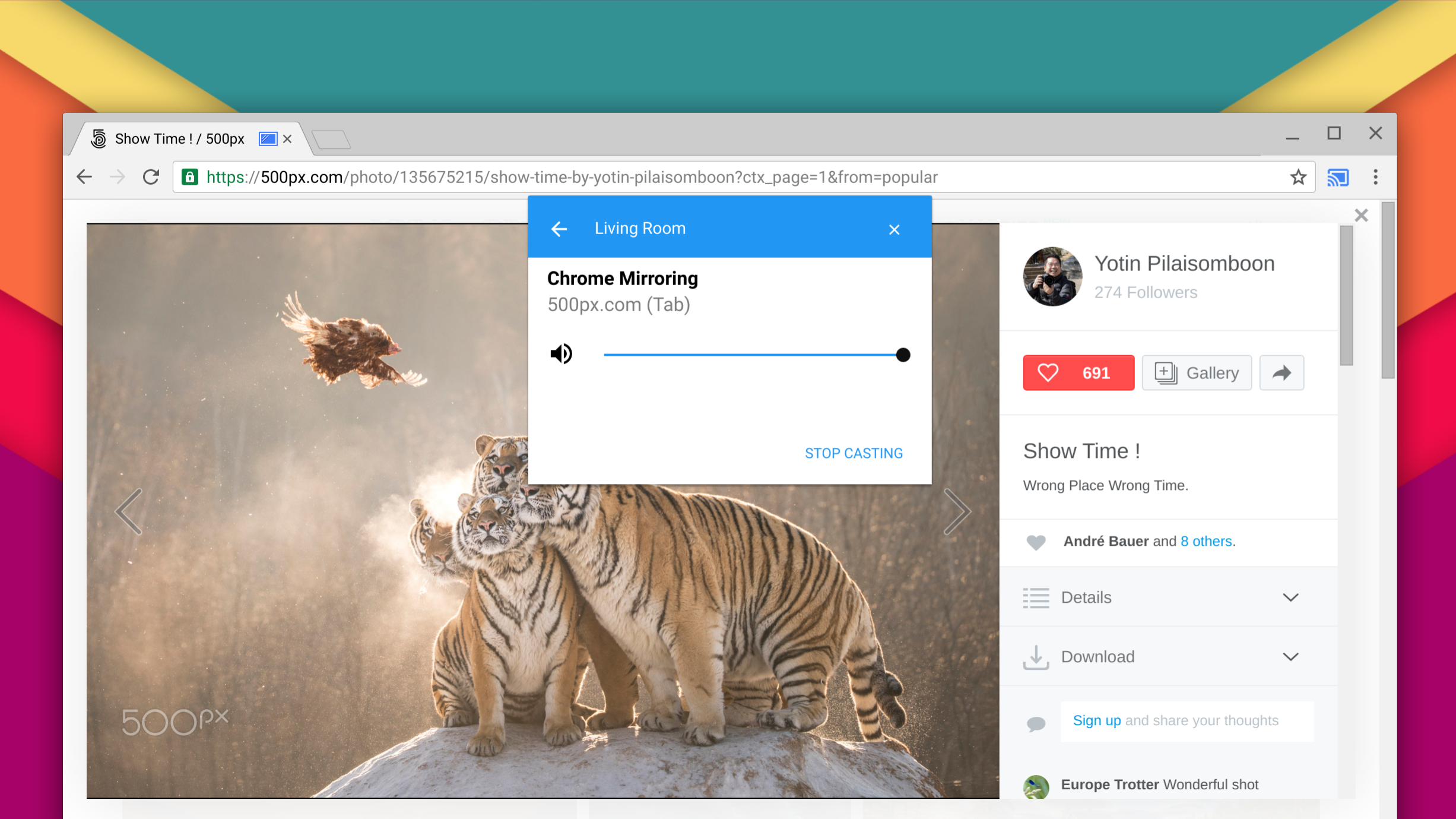
As of today, the ability to cast content to your Chromecast from the desktop comes in the form of a Chrome extension called Google Cast. As of the latest beta build of Chrome, though, you can now cast content from the web without said extension installed. All you have to do is right-click the content and use the “Cast…” menu…


Expand
Expanding
Close

Opinion: 8 reasons Chromebooks are beating iPads in education, and what Apple could do about it

Site default logo image

Apple for a time led the tech market in education, even making education-specific Mac models. More recently, the company made a big push on iPads, signing a $30M deal (that would eventually have been worth a quarter of a billion dollars) in 2013 to equip every student in the LA Unified School District with an iPad.

If that program had succeeded, it would have created a template for rolling out similar ones across the whole of the USA. Instead, it failed catastrophically, and it now appears that Chromebooks are winning where iPads have failed.

CNBC reported last month that Chromebooks now make up more than half of all devices in U.S. classrooms, while Apple’s share of classroom purchases more than halved between 2012 and 2015. Why is that, and what – if anything – can Apple do to reverse the trend … ?


Expand
Expanding
Close

Samsung introduces new, sleek 11.6-inch Chromebook 3

Samsung has joined ASUS in offering a new ultra-portable Chromebook for the masses this year at CES 2016. While ASUS went with a ruggedized look, Samsung has gone with a more sleek appearance, while still promising a durable and long-lasting build.

The new Chromebook 3 weighs a little over 2.5 pounds and has a reinforced metal body and 180-degree hinge to ensure that it’s not easily broken. What’s more, its shape and grippy finish are designed to make it easy to carry, but difficult to drop accidentally.

“We’re seeing more and more people flocking to Chromebooks as families, students and other consumers seek out easy-to-use, highly portable and affordable laptops as resources for personal use, education and even work,” said Gary Riding, senior vice president, Mobile Computing at Samsung Electronics America. “Samsung recognized that demand when we launched the first-ever Chromebook in 2011. We’re continuing to keep up with evolving consumer needs with this new iteration, which offers even more convenient features that solve consumers’ pain points, like all day battery life and fast charging capabilities.”

Specifications are typical of the smaller, more affordable Chromebooks:

  • 11.6-inch 1366 x 768 resolution anti-glare display
  • Intel Celeron N3050 processor
  • Intel HD GPU
  • 2GB or 4GB RAM
  • 16GB storage
  • 802.11ac Wi-Fi with 2x MIMO tech
  • Bluetooth 4.0
  • 2 x 1.5W stereo speakers
  • 720p built-in webcam
  • USB 3.0 and USB 2.0 ports
  • HDMI out
  • 3.5mm jack
  • MicroSD card slot
  • 11 hour battery life (33Wh)

Although exact pricing and release date details haven’t been announced, Samsung intends to launch the new Chromebook 3 at some point in the next few months. Similarly specced Chromebooks normally cost between $200-$250, anything more than that would surely make Samsung’s latest laptop unappealing.

ASUS’ new Chromebook C202 is hard to break, easy to fix

Over the past couple of years the Chromebook market has really taken off, particularly in education, where kids of all ages are being handed Chrome OS-powered laptops to complete work and research on. Part of the draw is that the platform gives users quick and painless access to commonly-used tools and programs in the cloud. The other part is that they are, mostly, very affordable.

Adding to the range of child-friendly Chromebooks already available is ASUS who, this morning, unveiled a brand new rugged notebook. The C202 has been designed specifically to withstand being dropped and to suffer the kinds of abuse kids often inflict on our gadgets. The entire device is wrapped in a durable rubber bumper, has a spill-proof keyboard and scratch-resistant shell.

As well as having an impact-resistant outer shell, the Chromebook also has a hinge which can be rotated 180-degrees. So, even if a child is a little too enthusiastic in opening it up, the C202 will survive. And if it doesn’t, it happens to be very easy to fix.

ASUS kitted out the Chromebook C202 with a modular body held together by regular screws. Its design means you’ll be able to replace parts like the battery, keyboard and power socket without having to send it to someone who has all the right proprietary screwdrivers.

Spec-wise, there’s nothing eye-watering here, it’s a pretty basic low-end Chromebook. The 11.6-inch resolution display has a resolution of 1,366 x 768 and is powered by an Intel Celeron processor paired with either 2GB or 4GB of RAM, combined with the usual 16GB storage. ASUS states it has 10 hours of battery, which normally means you can expect between 6-9 hours depending on usage. It’s also equipped with an HDMI out port, SD card reader and two USB 3.0 ports.

Pricing for the 4GB model will be between $220 and $230 USD when it launches in February.

Lenovo and Acer announce first USB-C monitors, making them ideal for Chromebook Pixel C

Site default logo image

If you have a Chromebook Pixel C and are looking for an external monitor for it, Lenovo and Acer have announced the neatest solutions yet, with a choice of 24-, 25- and 27-inch USB-C monitors.

Lenovo’s ThinkVision X24 Pro is the most basic, with a 1920×1080 resolution starting at $399, with availability in May. Acer’s H7 series monitors offer 2560×1440 resolution in 25- and 27-inch variants, and you’ll be able to get your hands on one of those next month, starting at $499.99.

Finally, Lenovo’s ThinkVision X1 is a 27-inch model offering 3840×2160 resolution, again from May, priced at $799 …


Expand
Expanding
Close

Lenovo announces ThinkPad 13 Chromebook, high-end notebook with two Type-C ports arriving in June for $399

Prepare for an influx of announcements from all the major tech companies over the coming days, CES 2016 is well and truly upon us. First out of the blocks is Lenovo who showed off a brand new 13-inch ThinkPad. The ThinkPad 13 will come in both Windows and Chrome OS flavors, and is priced right in the middle of the market…


Expand
Expanding
Close

Year in Review: These were the 10 most important moves that Google made in 2015

2015 saw many announcements and developments within the Mountain View company. It was a big one. While we may not have seen as many of the flashy moonshot projects we’ve seen announced over the last few years, like Google Glass, Project Loon, Project Titan, and others, 2015 came with some big changes, upgrades, products, and services. From Google being completely restructured to be a new huge conglomerate called Alphabet to the recent launch of the company’s Nexus line, 2015 wasn’t a boring one for Google by any stretch of the imagination.

Here’s are some of Google’s most important announcements, in no particular order…


Expand
Expanding
Close

Review: Dell Chromebook 13 (2015) is probably the best Chromebook around, but it’s not cheap [Video]

Looking at the Chromebook market, you could be forgiven for thinking it’s just the modern iteration of the netbook age. Small, cheap, underpowered plastic laptops that offer very little to anyone wanting a higher-end experience in a portable and affordable package. Dell changed that with the Chromebook 13. Now you can get a premium Chrome OS laptop without spending silly money on a Pixel. The Dell Chromebook 13 starts at $429 for the base model, and climbs to $899 for the top-tier. In the UK, it ranges from £484 to £856


Expand
Expanding
Close

Google explains why the new colorful hockey puck Chromecast looks so different

When we first exclusively leaked the 2nd generation Chromecast, we were dumbfounded by its design. Ditching the dongle-like look of its predecessor (that many other streaming sticks have come to mimic), the new Chromecast is more like a miniature hockey puck with a long HDMI cord attached, and comes in three bright colors. Many asked why a streaming device that sits behind the TV would need three colors, and Google has come out to answer this question and many others in a new interview…


Expand
Expanding
Close

Acer Chromebook R11 review: Great laptop, but Chrome OS is questionable in tablet mode

Chromebooks are all the same, but in this case that’s a good thing. The minimum hardware mandated by Google results in an affordable computer that runs a capable operating system. Since its inception six years ago, Chrome OS has been continuously updated with useful features, while in parallel, Google’s services have become immensely powerful and feature-rich for just being web apps.

While Chromebooks with touchscreens are not new, convertible Chrome OS devices are just starting to arrive. The Chromebook R11 is Acer’s first contribution to this field and I try to predominantly use it as a tablet in this review.


Expand
Expanding
Close

VLC launches on Chrome OS with support for all sorts of video & audio formats

The developers behind the popular media playback software VLC have today announced that the app is now available on Chrome OS. The team explained in a blog post that Chrome OS was one of the last operating systems on which you couldn’t run VLC, so today’s release has been a long time coming for users of the operating system.


Expand
Expanding
Close

Dell Chromebook 13 (2015) unboxing and first impressions [Video]


Of all the Chromebooks that were announced this year, it was the new Dell Chromebook 13 range that caught our eye. Unlike most Chromebooks, it’s not really low-end and cheap, but’s also not quite as extraordinarily priced as the Chromebook Pixel. It sits somewhere in between, right in no-man’s land. The cheapest model will set you back $429, while the most expensive is around $650 currently. In the UK, prices range from £484 to £856


Expand
Expanding
Close