Nexus



As the clock continues to click away to January 1st, we’re taking a look at our last top 9to5Google subject post of 2013. This time around we’ve saved the best for last as we look back at the last year in Android and the top 5 most read stories as determined by you, the 9to5Google reader. Perhaps the inevitable news is that 3 out of 5 or 60% of the top stories surround KitKat and its release. There were quite a few happenings in Android this year, but none more notable than the launch of the latest version of Android which has long been known as Key Lime Pie. Ultimately, Google decided on KitKat and announced the release with a partnership with the KitKat candy bar…which is exactly our kind of partnership. Facebook took its own stab at Android this year with Facebook Home and the HTC First, a story we’ll get to a little later on. I think it’s safe to call 2013 more of an evolutionary year in Android more so than revolutionary, but still another year where the platform surged in growth and adoption.

To say that 2013 has been an interesting year in the world of Android would be putting it mildly, but has it really been a banner year? The release of Android-oriented products like Google Glass, Google Hangouts/revamp of Google+ and the beginnings of Google Retail led the way for a whole new approach for Google to take on the competition.
As we look back at the Android-based smartphones that launched in 2013, there isn’t any one handset that truly stands out as a market revolution. Instead, 2013 saw improvements and innovation on existing brands and lines that were already incredibly popular. For example, the Galaxy S 4 which kicks off our list below didn’t really raise the bar over the Galaxy S III in a truly big way, but it did improve on an already market-leading experience from the Galaxy S III.
So without further adieu, here are the 9to5Google’s top Android smartphone picks for 2013:
Expand
Expanding
Close
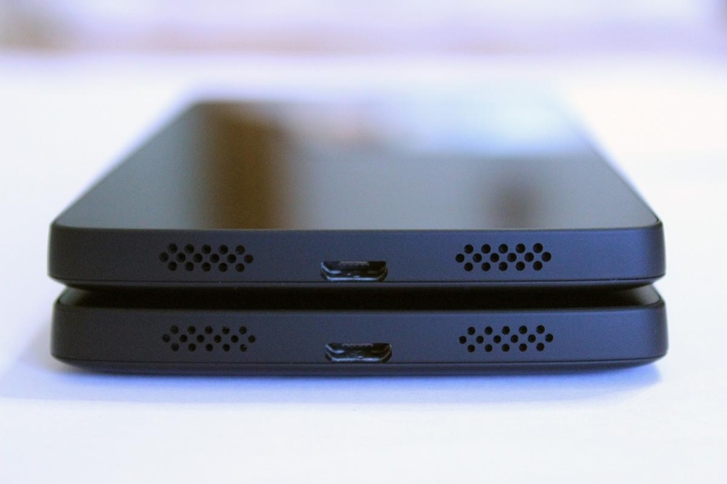
According to some a XDA-Developers forum thread, improved hardware for the Nexus 5 is now rolling out. The original batch of Nexus 5 devices is said to have suffered some minor hardware difficulties such as a protruding SIM tray, loose/noisy buttons and speaker-related issues.
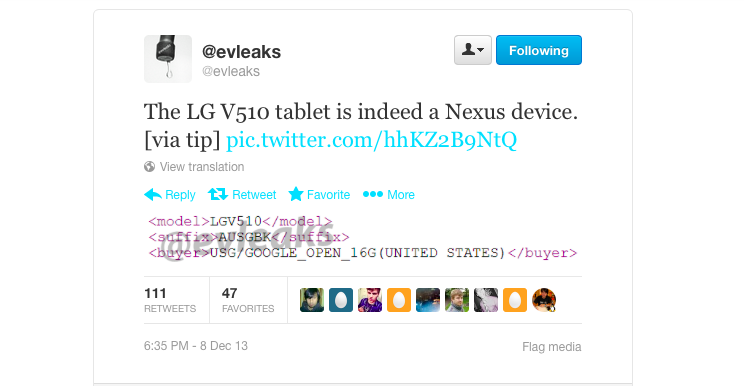
There’s little question a new Nexus 10 device is on the horizon, in fact we’re already passed a set of rumored release dates. In fact, we’ve already seen the LG-V510 surface thanks to a leaked image via Reddit that showed off a Nexus homescreen. In other words, there’s no “surprise” with this @evleaks tip, but one more confirmation is one step closer to believing this is the real deal.

For the past few months, rumors have been swirling that another living room device will soon be released by Google. In July, the Wall Street Journal reported on a device with a motion sensor and video camera, while GigaOM reported in October that Google was planning to drop the Google TV branding in favor of “Android TV.” This time around, The Information’s Amir Efrati reports that Google is planning to release a “Nexus TV” set-top box that will run Android.
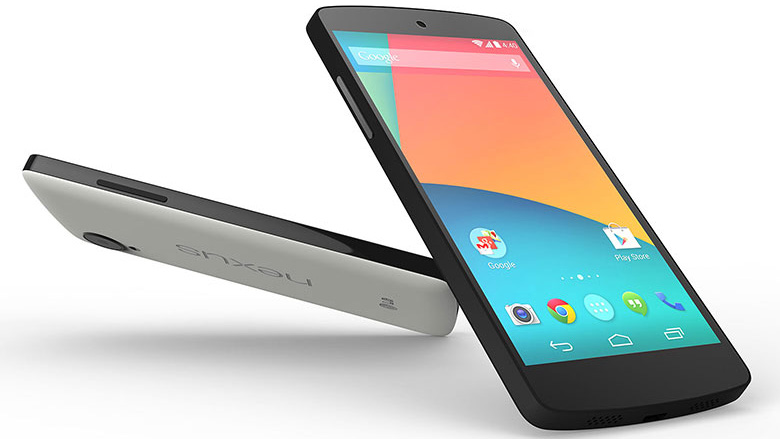
Update: Whoa, that was fast as a Google+ post courtesy of the Nexus team just announced Android 4.4.1 is rolling out right now to Nexus 5 devices.
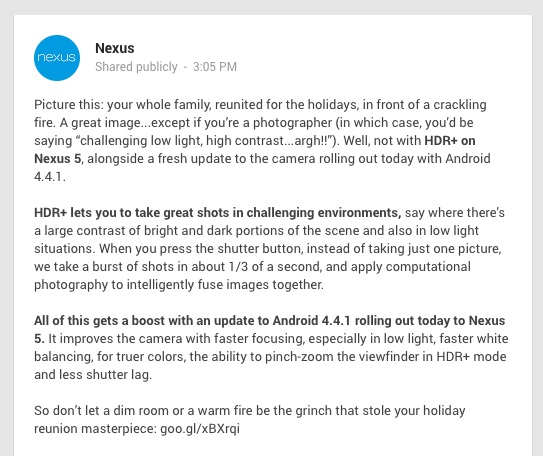
With a brief look at our analytics earlier this week, we discovered the existence of Android 4.4.1 in the wild. As it turns out, Android 4.4.1 is closer than we think as a new Verge report shows how Google is using this software update to attack the Nexus 5 camera’s shortcomings. According to Dave Burke, Google’s Director of Engineering for Android, 4.4.1 will begin rolling out over the next few days in the hopes of fixing the “buggy and inconsistent” camera that is the Nexus 5.

While the majority of Android users might still be a version or two behind despite some impressive upgrade numbers for KitKat, Google appears to be prepping the first update to KitKat with Android 4.4.1. A look at our analytics shows hits from a number of devices running 4.4.1 originating from Google’s home turf in Santa Clara, California. Above we can see a huge increase in hits from 4.4.1 devices over the last week.
Among the devices are both phones and tablets including the Nexus 4, Nexus 5, and Nexus 7:
Expand
Expanding
Close
A new report courtesy of the folks at ReadWrite is shining light on the steps and process Google’s engineers undertook to optimize Android 4.4 KitKat before its introduction to the world.
As Google’s engineers believed they reached a “feature parity” point, they turned their attention to performance and optimization, something that began with Android 4.1 Jelly Bean and “Project Butter.” The hope was that Android would be faster, more reliable and devoid of the crashes that plagued many Android users.
I’ve been thinking about this a lot lately as I recognize that when it comes to smartphone buying, I’m stuck in a crossroads about my next device. Yes, it’s true that my position as a tech blogger affords me the opportunity to try the latest and greatest, often at the same time. However, with a 10 month old my primary methodology for selecting a smartphone lately comes down to camera, camera and camera.
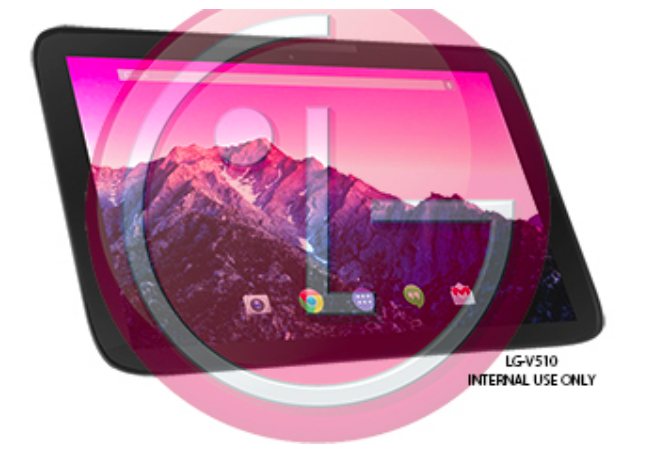
A combination of two separate images this weekend are pointing toward the next-generation Nexus 10 device complete with LG as the manufacturing partner. The first image (shown below) courtesy of Reddit and one incredibly unhappy Telefonica employee shows off the thinner bezel and what we believe is a front-facing speaker. The device also appears to be launching with Android 4.4 KitKat and the Google experience launcher in tow. Surprise, surprise.
Chalk this story up with a grain of salt but a new report indicates LG pushed for an alternative name for the Nexus 5. According to a Chosun IIbo, a major Korean newspaper the manufacturer wanted to name the device the “Nexus G.” The Nexus G nomenclature would fall more in line with LG’s current line of smartphones ala the Optimus G, G2, G Flex and G Pad. Anyone see the pattern, anyone?
I’ve already written about my disappointment in the Nexus 5 camera and that’s exactly why this news out of XDA Developers is grabbing my interest. A developer by the name of Jishnu Sir created a flashable .zip file that is said to greatly improve the quality of the camera. Any flashable file requires an unlocked bootloader and a custom recovery but beyond those extras, the “new” camera app will add or improve:

As I come up on a week of use with the LG Nexus 5, a few things become clear:
How did I draw these conclusions? Start the week ago flashback sequence…
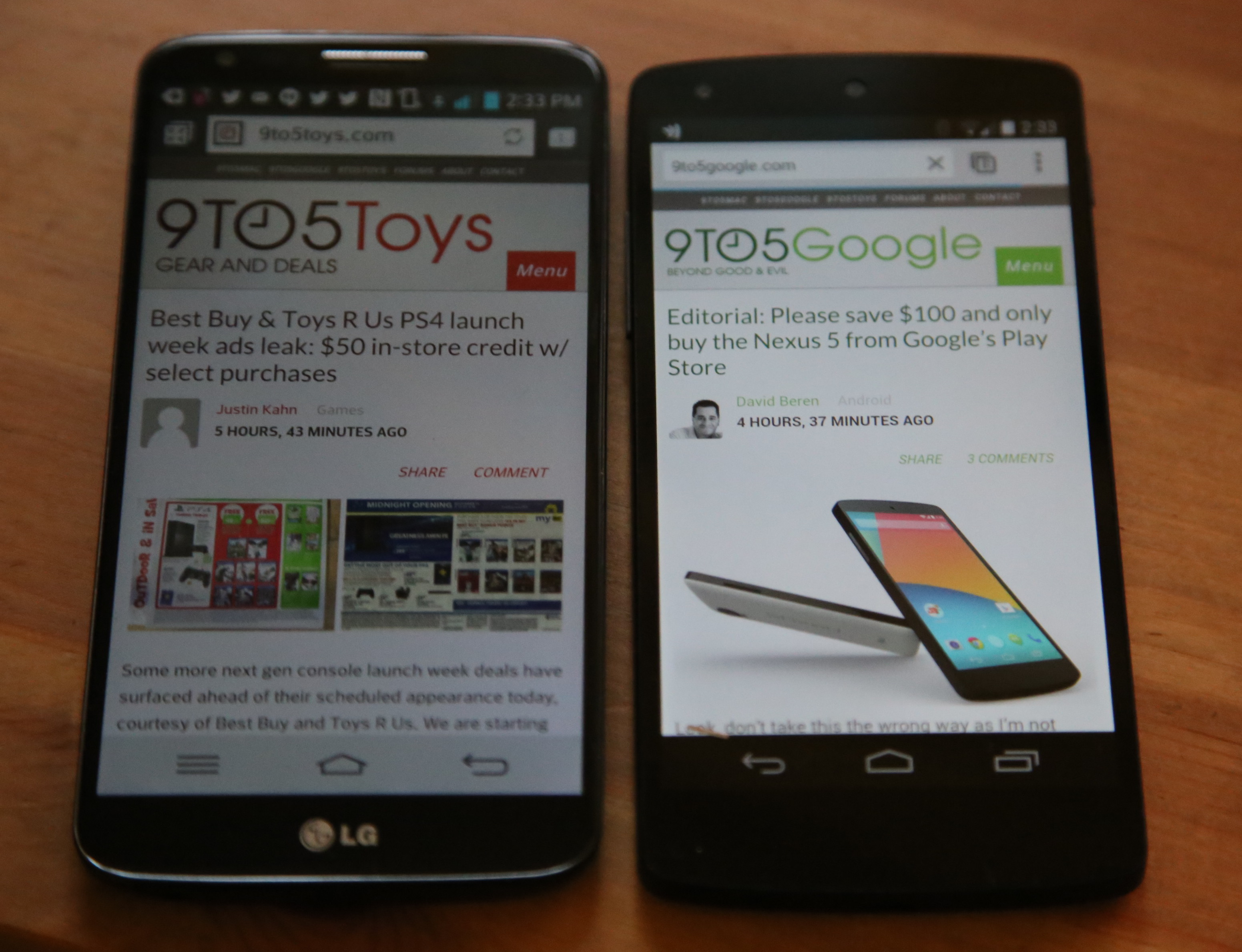
Look, don’t take this the wrong way as I’m not suggesting buying the Nexus 5 from your carrier of choice is a bad move, except that’s exactly what I’m saying. The thing is, it isn’t even the carriers fault as they are simply passing on their cost of the Nexus 5 purchase from LG/Google directly to you. Sprint and T-Mobile have both confirmed that their cost of the Nexus 5 is $450 indicating that Google is subsidizing their pricing of the Nexus 5 via the Play Store. Just like last year’s Nexus 4.
Yes, there is an argument to be made that not having to fork over the entire up-front cost is something that could appeal to many potential Nexus 5 buyers. However, in the long run I’d rather see customers saving the extra $100 and putting it toward apps, accessories or paying the electric bill. It’s likely Google is taking the $100 loss in the hopes of pushing customers into the Play Store where they will grab apps, books, movies, magazines and all the other things Google will make a profit on. More Nexus users means more Google Maps and search use, more money, more money…
[Ed. note: If you want to save even more money, T-Mobile still offers a super secret Web only $30/month pre-paid plan (meaning little-no taxes) that works great with your Nexus 5. You have to scroll to the bottom of T-Mobile’s plans page to find it—->. It includes unlimited data (throttled at 5GB), unlimited texts and a sparse 100 minutes of talk time. If you aren’t a talker, you are looking at $360 for a year of unlimited data + $350 for the best Android phone (under $60/month total) out there!]
[protected-iframe id=”492e2c57048e6da0fc41819addecc350-22427743-13611283″ info=”http://assets-polarb-com.a.ssl.fastly.net/api/v4/publishers/9to5mac/embedded_polls/iframe?pollset_id=200-nexus5iphone5s” width=”100%” height=”425″ style=”border: none;”]
The results from our Nexus 5 vs. iPhone 5s photo quality survey are in. The winner is probably not a surprise (the iPhone 5s) but the margin may have been a bit of a surprise after so many people rated the Nexus 5 camera so poorly (and Google subsequently offered promises of fixes).
At the time we turned on the answers, the iPhone won about 55% of the votes overall from over 200,000 votes placed.
Nexus 5 − 89724 (45%)
iPhone 5S – 110828 (55%)
After testing the Nexus 5 camera for a few days, it is pretty clear that it isn’t the best shooter out there, and even the best Android shooter. But it also isn’t that bad. In fact, I think it might be a bit better than other high profile phones like the MotoX. The weaknesses in the survey and in my own testing is in speed (it is slow, especially in low light), Low light images in general weren’t great and paradoxically over-exposure outside in well lit situations (though people in the survey seemed to appreciate that bias) seemed to happen frequently with the Nexus 5.
The bottom line however is that the Nexus 5 camera isn’t the best but it really isn’t that bad – especially for a $350 phone. Full results before we turned on the labels below:
Expand
Expanding
Close
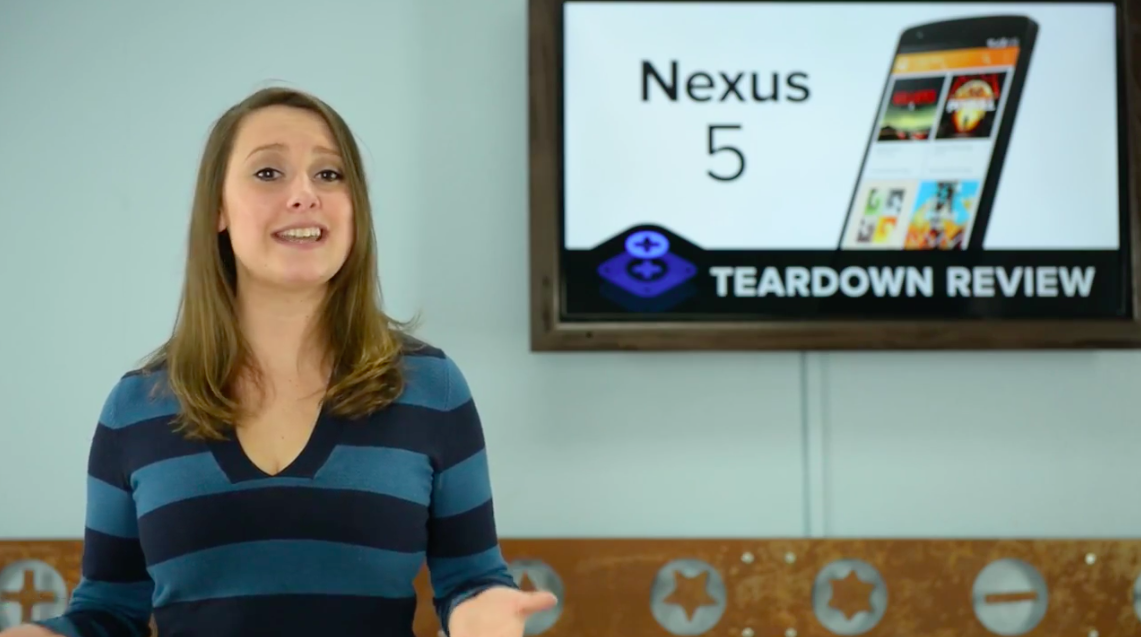
There are few things I look forward to more with a high-profile handset launch than the iFixit tear down. The good folks at the company are tearing the Nexus 5 up as only they can do and showing us all the wonderful cords, plugs, parts, pieces and everything that makes up Google’s newest flagship device.
Some notable takeaways from the video include the discovery the battery is held in place with only “very mild adhesive” making it “fairly easy to remove and replace.” Ten #00 Philip head screws hold everything in place “simplifying repairs and reassembly.” As for any bad news, that arrives with the glass and LCD both fused to the display frame making any fixes to the glass either “expensive or very difficult.”
Ok, so we’ll take the good with the bad but watching the whole video is more than worth the 3:45 of your time.
via iFixit
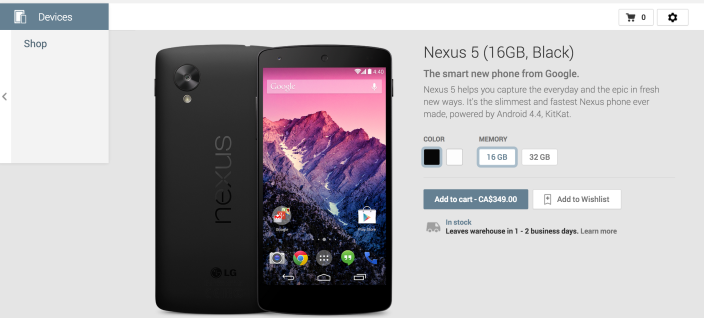
When Google’s Vic Gundotra promised “insanely great cameras” on upcoming Nexus devices, we took his statement to heart. Now, with the release of the Nexus 5, early reviews of the camera are decidedly mixed. It’s for this reason that I’ve decided to take a pass on the newest Nexus device, and will continue to focus on Android devices where the camera doesn’t appear to be an afterthought. I had hoped that we might see something that truly lived up to Vic’s “vision” for the Nexus line of smartphone cameras, needless to say, “insanely great” doesn’t seem to apply.
Now, I grant you, some of the pictures I’ve seen from the Nexus are good—some are very good—but the consensus seems to be for every “very good,” there’s “not so good.” As a new-ish parent, a smartphone camera is one of the most important aspects of my life, as the best camera I have is the one I have with me. I want to love the Nexus, the large display and quick updates and all the sunshine and rainbows that comes from owning Google’s flagship device. Still, the real-world tests don’t give me much hope that is the right Android device for me:
There’s no question that with every new smartphone release, we look at the camera, the display and ultimately, the battery. As the Nexus 5 begins making its way to the masses, some new software and performance enhancements will offer a slight boost in battery life.
As GigaOM points out, the inclusion of Qualcomm’s new “envelope tracking technology” will make the Nexus 5 a more battery friendly, power-efficient smartphone. Qualcomm’s envelope tracker, dubbed the QFE1100 was first introduced to the world with the Galaxy Note 3, highlighting the Nexus 5 as the second smartphone to include the tech.
Expand
Expanding
Close
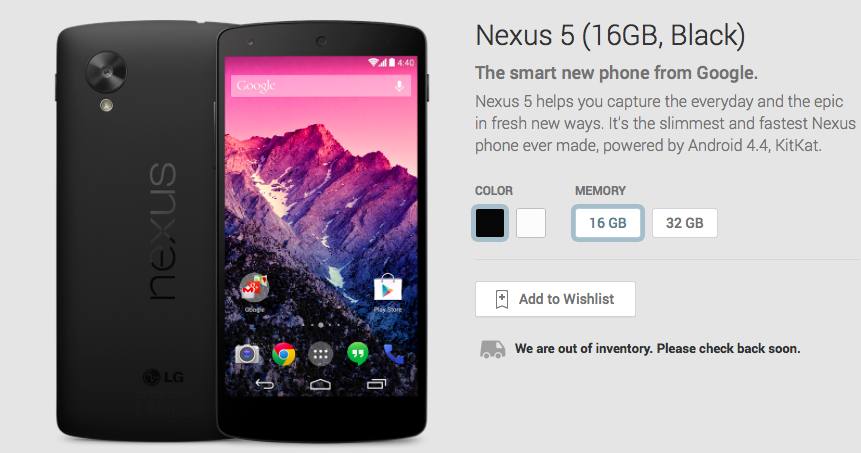
When it comes to Google, we’ve come to expect the literally insane for new product launches with skydivers and Google Glass or very low key events for Google+/Chromebooks. Someone tell me then why Google launched the Nexus 5 and their next piece of software with Android 4.4 KitKat with almost no fanfare? It feels as if the KitKat announcement some months back saw more press and activity than the actual launch itself.
Yes, one could argue that Nexus device sales are limited to the geeks and die-hard Android fans. Yes, one could say that KitKat is more of an evolution than a revolution and that Google didn’t need to go all-out yesterday as the ridiculous set of device leaks created all the buzz they needed. Still, this is Google and this is a Nexus and at the very least, Google could have at least done a small event to boost awareness.
With Android 4.4 KitKat finally officially announced, many users now begin the agonizing process of waiting for their device to receive the update. As we are all well aware off, it can take a long time for Android updates to make their way to the majority of users. Things have started to improve recently, however, and with the release of Android 4.4, several manufacturers have already announced their upgrade plans. Here’s a running list of devices already confirmed to get the udpate along with release dates:
Expand
Expanding
Close

After leaking a clear image of the black model yesterday, prolific leaker @evleaks has posted a render of the upcoming Nexus 5 in a white color option. As can be seen in the image above, the white model is actually a two-tone device: a black front, a white back, and black accents around the sides and rear-camera system…
[tweet https://twitter.com/evleaks/status/385532994527567872]
We’ve already heard some rumblings of a Asus powered Nexus 10 tablet (to be honest, I’m not a huge fan of ASUS hardware so kinda bummed), but today evleaks has some further evidence of the existence of said tablet.
Honestly, I hope it is better than the current version but now I’m starting to think it might just be cheaper.

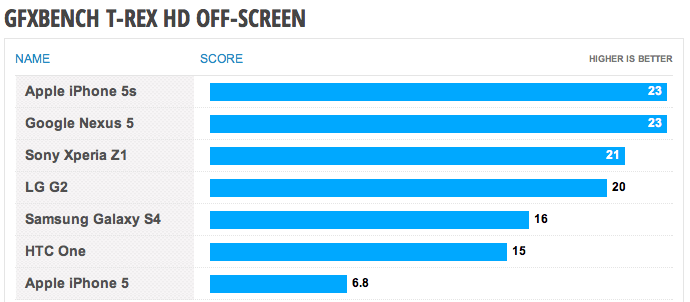
The Nexus 5 appears set to match or beat the iPhone 5s in graphics performance, according to benchmark data posted on the the GFXBench website, achieving 23.1 frames per second in a key test.
The GFXBench T-Rex tests are one of the most demanding tests of the graphics performance of a phone, and provide a particularly good guide to how well a handset is likely to fare when paying graphics-intensive games. The just-released iPhone currently tops the T-Rex scores, but one of the four tests appears to show that the Adreno 330 expected to be used in the Nexus 5 will at least equal that performance …
Expand
Expanding
Close
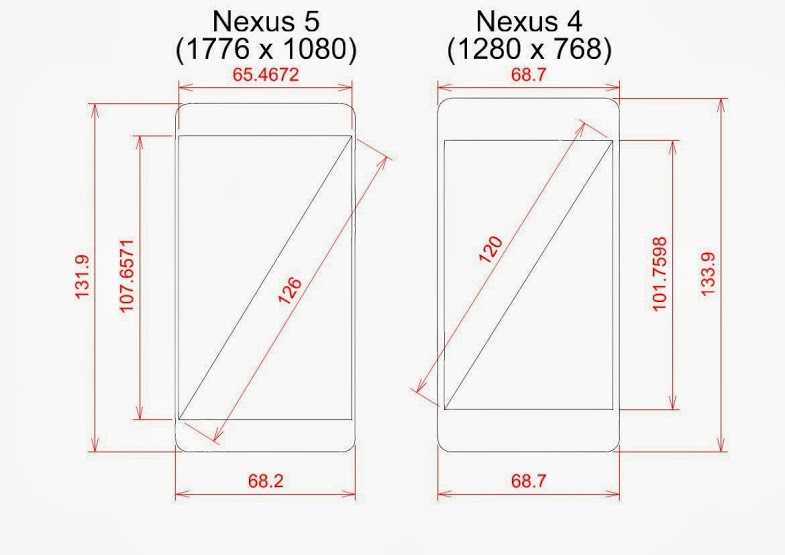
Developer Jack Underwood took the dimensions from the recent FCC approval of the LG D820 that has been pretty much confirmed as the Nexus 5 and compared them to the Nexus 4. The result? Despite a larger screen size with higher resolution, the Nexus 5 is actually smaller in every dimension.
If there were any lingering doubt about the match between the casings shown and the device slipped into the KitKat video, the animated GIF below seems to provide conclusive proof …
Expand
Expanding
Close