Android

See All Stories

Breaking news for Android. Get the latest on apps, carriers, devices, and more!
Android is Google’s mobile operating system, launched in September 2008, although its history technically began with the release of the Android alpha in November 2007. To this day, Android powers the majority of the world’s smartphones and comes in several different flavors across many phone makers.

What is Android?

Android Inc.

Android, before it was Android, was a company called Android Inc. That company was founded in Palo Alto, California, in 2003 by a crew of four: Andy Rubin, Rich Miner, Nick Sears, and Chris White. The company and its project was acquired by Google in 2005 for a sum of more than $50 million, although the exact number is unknown. The company’s founders joined Google as part of the deal.

In its infancy, Android was an operating system built not for touch screen smartphones like the iPhone, but rather BlackBerry-like devices with physical keyboards. It’s well documented that after Apple shocked the world with the iPhone, ahead of its nearest competition by at least a couple years, Google and Android Inc. had to go back to the drawing board to build something competitive.

Adoption by third-party makers

It didn’t take long after the launch of the iPhone for various manufacturers to enter the market with their alternatives — and Google’s Android immediately became the obvious platform of choice for just about everyone except Microsoft. HTC was the first manufacturer on board, and introduced the T-Mobile G1 running Android in September 2008. Soon after, HTC, Motorola, Samsung, and carriers like Sprint and T-Mobile jumped on board to form the Open Handset Alliance.

Android makers across the world

Iconic Android handsets

There have been thousands of Android phones released since Android’s inception, but some have been more important to the platform’s history than others. There was the original T-Mobile G1, as mentioned, but there was also the HTC One Google Play Edition, Moto G, Samsung Galaxy S4, and others. Some of the most iconic Android handsets include:

  • HTC G1
  • HTC Nexus One
  • Samsung Galaxy S, S2, S3, S4, and their successors
  • HTC Incredible S
  • Samsung Nexus S
  • Samsung Galaxy Nexus
  • Samsung Galaxy Note
  • Nokia 8
  • BlackBerry KeyOne
  • Google Pixel and its successors

In more modern times, there are several Android smartphones makers that popped up across various niches and in several international markets. Huawei is a dominant Android maker in China and many European markets, while Samsung is by far the most popular maker in the United States by far — effectively creating a duopoly with Apple. Today, there are dozens of major device makers contributing to the Android ecosystem.

Full list of Android OEMs

History of major Android versions

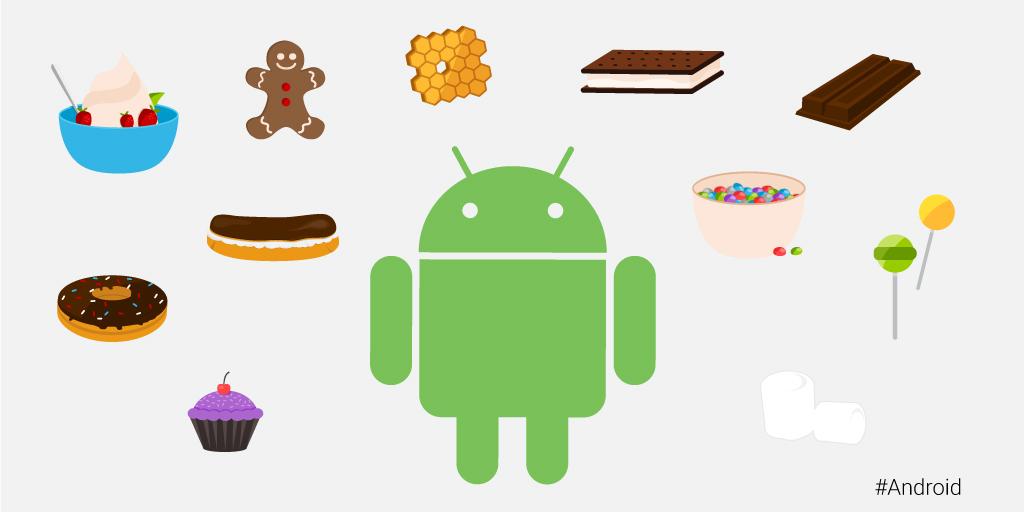
Android has seen countless software revisions over the course of its life, but in modern times the OS usually sees a major release on an annual cadence. In the earlier days, Google famously gave its major software releases dessert-themed codenames, but retired that practice in 2019 with the release of Android 10.

VersionNameReleaseDevices
2.3GingerbreadFebruary 9, 2011Nexus S
4.0Ice Cream SandwichOctober 19, 2011Galaxy Nexus
4.1Jelly BeanJuly 9, 2012Nexus 7
4.2Jelly BeanNovember 13, 2012Nexus 4, 10
4.3Jelly BeanJuly 24, 2013Nexus 7 (2013)
4.4KitKatOctober 31, 2013Nexus 5
5.0LollipopNovember 3, 2014Nexus 6, 9
5.1LollipopMarch 9, 2015Android One
6.0MarshmallowOctober 5, 2015Nexus 5X, 6P
7.0NougatAugust 22, 2016Nexus 5X, 6P
7.1NougatOctober 4, 2016Pixel, Pixel XL
8.0OreoAugust 21, 2017Pixel, Pixel XL
8.1OreoDecember 5, 2017Pixel, Pixel XL
9PieAugust 6, 2018Pixel 2, Pixel 2 XL
1010September 3, 2019Pixel 3, 3a
1111September 8, 2020Pixel 4

List of major Android OS platforms

While Android proper is certainly the most widespread of Google’s Android operating systems, the company has also launched many offshoots of the main OS over the years. There’s Android Auto, Android Wear (now Wear OS), Android TV (now rebranded to Google TV), as well as versions of Android built for tablets and Android Things (now defunct).

Moto Z2 Force Review: The screen’s not shattered, but my heart is [Video]

Motorola used to be my favorite Android OEM. The company made excellent smartphones, were one of the best in terms of software, and clearly listened to customers to deliver something that was unique and fun to use. Then, Lenovo bought them. As much as I enjoy Lenovo products, I was scared to see what would happen to Motorola, and just as I and many others feared, things went south.

A lot of the great things Motorola was doing were scrapped, but the company still continued to impress. The introduction of the Moto Z line was jarring, but interesting and unique. This year, we’ve got the Moto Z2, and it’s shattered a lot of what I previously loved about the Z line.


Expand
Expanding
Close

LG V30: Handset’s 6-inch, ‘bezel-less’ P-OLED FullVision display gets iPhone 8 treatment

Last night, LG posted a press release to announce that its “next flagship,” better known as the LG V30, will be the first device ever to use a plastic OLED FullVision display. While leaked renders and outlines already gave away the fact that the V30 would feature a “bezel-less” display with rounded corners, this announcement states that the handset will also have a 6-inch screen…


Expand
Expanding
Close

Asus ZenFone AR: Now available for pre-order from Verizon for $648

Update: Asus has now officially announced Verizon availability and also says that the unlocked ZenFone AR will be available in two variants: 6GB RAM and 64GB storage for MSRP $599 and 8GB RAM and 128GB storage for MSRP $699.

Back at CES in January, Asus unveiled two new phones: the Zenfone 3 Zoom and the Zenfone AR. While the 3 Zoom went on sale back in May, Asus has been quiet on when it would finally make the Zenfone AR available to customers. Without any official announcement, the Zenfone AR showed up on Verizon’s website today for pre-order…


Expand
Expanding
Close

LG V30: Reports claim a massive f/1.6 aperture, floating bar to replace second screen

With its upcoming LG V30, LG hopes to not only make up for poor sales of the G6, but also introduce a few new features that include ditching the second screen and going with a new display technology. According to new reports, though, LG may be planning to break records in the mobile camera department, as well as giving users who loved the “second screen” an alternative.


Expand
Expanding
Close

Android app icons: Do you prefer adaptive and uniform (new) or unique and distinct (old)? [Poll]

With Android 8.0, Google is implementing something called Adaptive Icons, which allow the end-user to decide the uniform shape they want all of their installed app icons to look like. Unfortunately, with this change, apps that have uniquely-designed icons like the old Slack app and Adsense will have to be changed to work with the new system.

Do you prefer the new round and uniform or old unique and personalized application icons?


Expand
Expanding
Close

Gold-plated BlackBerry Keyone now available for around $817

Following some leaked images last week, an all-black version of the BlackBerry Keyone was announced for availability in India starting on August 8. The absence of the silver trim in favor of a matte-black getup is extremely stealthy and sleek, but if you’re someone who desires more pizazz with your smartphone purchases, there’s now a gold-plated Keyone that you can pre-order right now.


Expand
Expanding
Close

Comment: Round & Adaptive icons mark the sad end of distinct icon designs in Android

Be together. Not the same” remains a fairly fitting tagline for Android as it aptly describes the diversity found in the hardware and software experiences for Google’s mobile operating system. The statement also perfectly describes distinct parts of Android today, including the new Adaptive Icons found in 8.0.

With the new 8.0 feature, it’s easier than ever for icons to be displayed in a “variety of shapes across different device models.” While a win for customizability and (to some extent) uniformity, it is far from an excuse to lazily drop your existing icon into a circle…


Expand
Expanding
Close

Moto G5S Plus: Heading to the U.S. this fall with dual 13MP cameras, 5.5-inch screen, and higher price

Ever since this past May, we’ve been hearing murmurings of an upcoming Moto G5S Plus that would improve upon Motorola’s awesome budget offering, the G5 Plus. Motorola officially unveiled the G5S Plus today, and while there’s nothing here that’s all that surprising, the device still looks quite solid.


Expand
Expanding
Close

Hands-on: Moto E4 Plus has 5 big differences compared to the E4

Motorola Moto E4 Plus, following its little sibling, is hitting the US soon. The phone’s release comes not too long after the launch of the regular E4 (which we already reviewed), and while we’re still taking a closer look at this variant of the phone, we thought we’d share the five biggest differences we’ve noticed between the two phones in the meantime…


Expand
Expanding
Close

Samsung Galaxy Note 8: ‘Midnight Black’ model leaks in new render

We are less than a month out from Samsung’s Galaxy Unpacked event where the company will announce the Note 8. Thanks to previous leaks, we already have a good idea of what the device will look like. The latest leak, coming from Evan Blass on Twitter, shows off what the front of the handset will look like in its Midnight Black paint job…


Expand
Expanding
Close

Samsung teases the Note 8’s dual-camera features including 3x optical zoom as phone passes through FCC

The revival of the Note series in the Galaxy Note 8 is one of the most highly-anticipated releases this fall, and among other things, one of the phone’s most interesting features is the dual-camera system. While we’ve seen several OEMs adopt this feature to varying levels of success, Samsung’s first mainstream dual-camera is one to be excited about, even though we haven’t known anything about what it can do. That is, until today.


Expand
Expanding
Close

Google may be finally adding Bluetooth battery indicators in an upcoming Android version

Sometimes it’s the little things that are the most frustrating, and you can say that about Android quite a lot, unfortunately. One of those issues which users have complained about for years is the lack of a Bluetooth battery indicator in the OS, but it seems that Google is finally delivering on that feature in a future version of the OS.


Expand
Expanding
Close