Android

See All Stories

Breaking news for Android. Get the latest on apps, carriers, devices, and more!
Android is Google’s mobile operating system, launched in September 2008, although its history technically began with the release of the Android alpha in November 2007. To this day, Android powers the majority of the world’s smartphones and comes in several different flavors across many phone makers.

What is Android?

Android Inc.

Android, before it was Android, was a company called Android Inc. That company was founded in Palo Alto, California, in 2003 by a crew of four: Andy Rubin, Rich Miner, Nick Sears, and Chris White. The company and its project was acquired by Google in 2005 for a sum of more than $50 million, although the exact number is unknown. The company’s founders joined Google as part of the deal.

In its infancy, Android was an operating system built not for touch screen smartphones like the iPhone, but rather BlackBerry-like devices with physical keyboards. It’s well documented that after Apple shocked the world with the iPhone, ahead of its nearest competition by at least a couple years, Google and Android Inc. had to go back to the drawing board to build something competitive.

Adoption by third-party makers

It didn’t take long after the launch of the iPhone for various manufacturers to enter the market with their alternatives — and Google’s Android immediately became the obvious platform of choice for just about everyone except Microsoft. HTC was the first manufacturer on board, and introduced the T-Mobile G1 running Android in September 2008. Soon after, HTC, Motorola, Samsung, and carriers like Sprint and T-Mobile jumped on board to form the Open Handset Alliance.

Android makers across the world

Iconic Android handsets

There have been thousands of Android phones released since Android’s inception, but some have been more important to the platform’s history than others. There was the original T-Mobile G1, as mentioned, but there was also the HTC One Google Play Edition, Moto G, Samsung Galaxy S4, and others. Some of the most iconic Android handsets include:

  • HTC G1
  • HTC Nexus One
  • Samsung Galaxy S, S2, S3, S4, and their successors
  • HTC Incredible S
  • Samsung Nexus S
  • Samsung Galaxy Nexus
  • Samsung Galaxy Note
  • Nokia 8
  • BlackBerry KeyOne
  • Google Pixel and its successors

In more modern times, there are several Android smartphones makers that popped up across various niches and in several international markets. Huawei is a dominant Android maker in China and many European markets, while Samsung is by far the most popular maker in the United States by far — effectively creating a duopoly with Apple. Today, there are dozens of major device makers contributing to the Android ecosystem.

Full list of Android OEMs

History of major Android versions

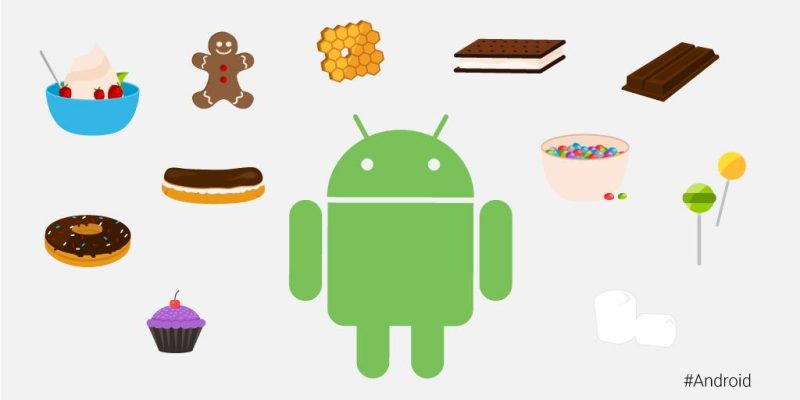
Android has seen countless software revisions over the course of its life, but in modern times the OS usually sees a major release on an annual cadence. In the earlier days, Google famously gave its major software releases dessert-themed codenames, but retired that practice in 2019 with the release of Android 10.

VersionNameReleaseDevices
2.3GingerbreadFebruary 9, 2011Nexus S
4.0Ice Cream SandwichOctober 19, 2011Galaxy Nexus
4.1Jelly BeanJuly 9, 2012Nexus 7
4.2Jelly BeanNovember 13, 2012Nexus 4, 10
4.3Jelly BeanJuly 24, 2013Nexus 7 (2013)
4.4KitKatOctober 31, 2013Nexus 5
5.0LollipopNovember 3, 2014Nexus 6, 9
5.1LollipopMarch 9, 2015Android One
6.0MarshmallowOctober 5, 2015Nexus 5X, 6P
7.0NougatAugust 22, 2016Nexus 5X, 6P
7.1NougatOctober 4, 2016Pixel, Pixel XL
8.0OreoAugust 21, 2017Pixel, Pixel XL
8.1OreoDecember 5, 2017Pixel, Pixel XL
9PieAugust 6, 2018Pixel 2, Pixel 2 XL
1010September 3, 2019Pixel 3, 3a
1111September 8, 2020Pixel 4

List of major Android OS platforms

While Android proper is certainly the most widespread of Google’s Android operating systems, the company has also launched many offshoots of the main OS over the years. There’s Android Auto, Android Wear (now Wear OS), Android TV (now rebranded to Google TV), as well as versions of Android built for tablets and Android Things (now defunct).

You might be able to sort-of see today’s eclipse through Google Cardboard

As great as today’s solar eclipse will be, you need special eye protection in order to properly view the it without doing moderate damage to your retina. There are a few different ways to go about this, but one way to do so — although definitely not ideal — could be with a phone, Google Cardboard, and a virtual reality camera capture app from the Play Store…


Expand
Expanding
Close

Watch Google’s Android O mascot unveiling event right here [Livestream]

The day has arrived for the unveiling of Android O’s mascot. This event has traditionally been an Android statue unveiling party at the Googleplex in Mountain View, but this year Google’s mixing things up a bit: the company is announcing the mascot and name for Android O in New York City at an event perfectly coinciding with today’s solar eclipse…


Expand
Expanding
Close

The built-in app locker in OxygenOS isn’t all that secure, OnePlus working on a fix

OxygenOS — the Android ROM that’s present on OnePlus phones — comes outfitted with a lot of exclusive features and customization options that you won’t find on stock Android. One of OxygenOS’s most useful additions is a built-in app locker, but as evidenced by a recent ‘hack’, this extra security measure isn’t as secure as it should be…


Expand
Expanding
Close

Review Roundup: Essential Phone has fast software, excellent hardware, but low-light camera performance as bad as the app icon

After finally going on sale yesterday, the first reviews have dropped on the first phone from Andy Rubin’s startup, the Essential Phone. The bezel-less device indeed suffered delays (and weathered hype for other devices), but the remaining question is the tried-and-true: Is it actually worth buying? We’ll answer that ourselves soon, but in the meantime, here’s what others are saying…


Expand
Expanding
Close

Galaxy Note 8: Brochure leak confirms final specs and design ahead of next week’s event

We’re less than a week away from the official announcement of the Galaxy Note 8, and if you’ve been following our updates on Samsung’s upcoming flagship for the past couple months, you’ll know that the device’s design, specs, and more have been leaking like crazy. An official brochure was recently spotted for the Note 8, and it officially confirms much of the phone’s final design and specifications.


Expand
Expanding
Close

Google essentially just confirmed that Android O will be ‘Oreo’

While Google has yet to officially confirm the name of the upcoming version of Android, Android O, it’s been widely speculated that it will be Oreo. After all, there aren’t many other desserts that start with an O, so it makes sense that Google would pick it. Today, in a since-deleted teaser posted on Google+, the company basically confirmed that this is true.


Expand
Expanding
Close

Likelihood that top Googlers use Android Wear in their normal life, rated (w/ evidence) [Gallery]

Android Wear has been a rollercoaster of emotions for Google fans. The initial teasers showing the Moto 360’s beautiful circular display pretty much gave butterflies to green robot fans everywhere, but since, the platform, and smartwatches in general, have struggled to live up to their promise. Even with awesome new hardware, lots of people just don’t wear their Wear anymore. But what about Googlers?


Expand
Expanding
Close

LG V30: Behind the scenes on the creation of the handset’s wallpapers [Video]

At this point, LG is no longer trying to keep the V30 a secret. Between leaked photos and video of the phone and the company already talking about the handset’s new software, all there’s left to do is build hype for the new phone before its announcement at IFA.

LG’s latest attempt at doing just that is a behind the scenes look at the creation of the handset’s wallpapers…


Expand
Expanding
Close

Motorola has patented a smartphone display that can heal itself of cracks

Smartphones are pretty expensive, but they’re also fragile. A simple drop can sometimes result in a shattered, unusable phone. Motorola has pushed forward in fixing this problem fir consumers by introducing a technology it calls ShatterShield on phones like the Moto Z2 Force, but it seems like that isn’t the only idea the company has had to fix this problem…


Expand
Expanding
Close

Android Instant Apps now work on 500 million devices across the globe

Google first announced Android Instant Apps — the service that allows you to use partial apps via Chrome — back at I/O 2016. The rollout has been a slow one to say the least, and following Android Instant Apps first going live as “limited tests” back in January, Google has announced that more than 500 million devices now have access to it…


Expand
Expanding
Close

BlackBerry Keyone: Sprint is working on a fix for unremovable bloatware

At the beginning of the week, we reported that BlackBerry Keyone users on Sprint were experiencing an issue with not being able to completely delete pre-installed apps from the phone. Our assumption at the time was that this had to do with a bug with the SprintID system app, and thanks to a confirmation from the carrier, that does in fact appear to be the case…


Expand
Expanding
Close

BlackBerry Keyone: Teardown reveals addition of adhesive to prevent screens from popping off

The BlackBerry Keyone is a pretty solid phone, especially as far as the hardware is concerned. It feels like a tank in hand, but it was quickly discovered that there was a major flaw — the phone didn’t have any adhesive behind the display to keep it in place. That led to customers having their screens pop off. Thankfully, it’s now been confirmed that BlackBerry has put a fix in place.


Expand
Expanding
Close